
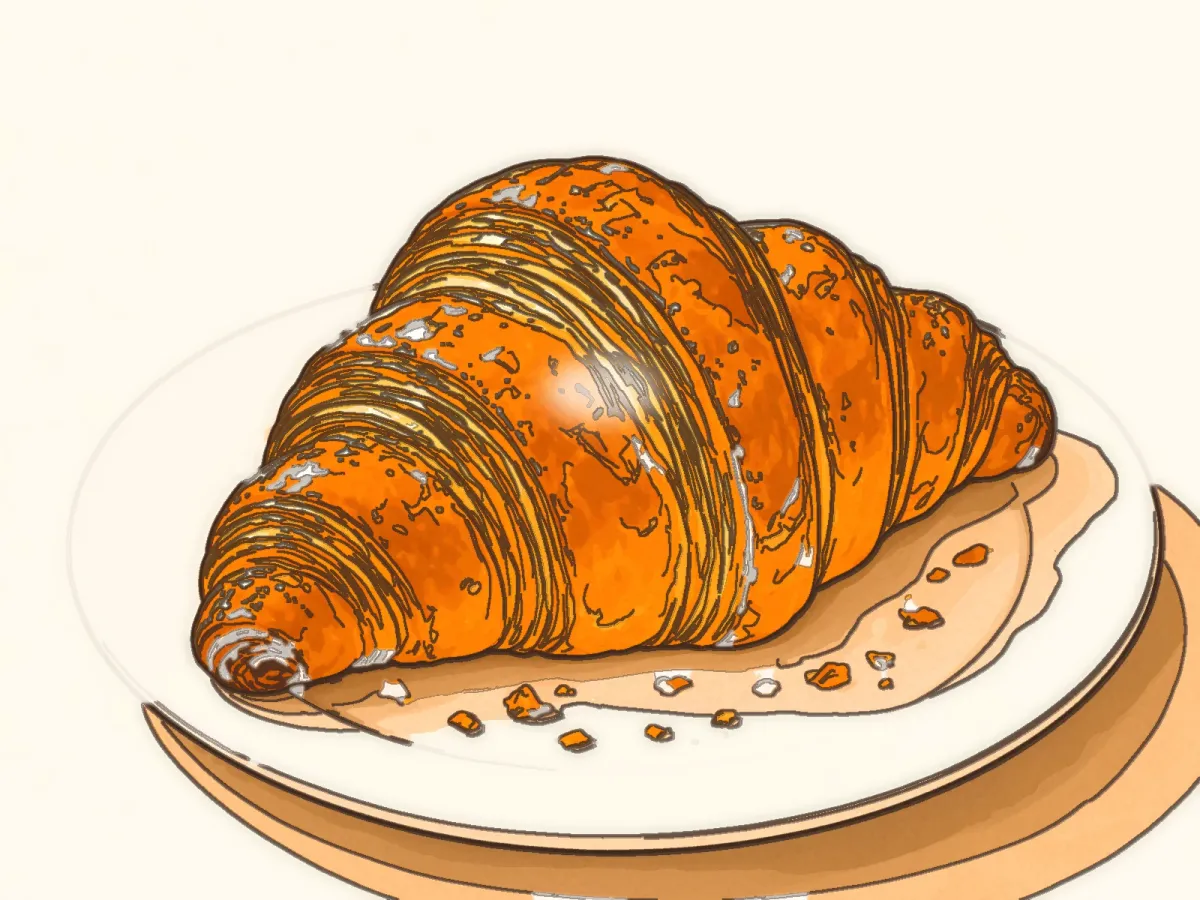
At a baking competition, an apprentice presents a croissant with hundreds of layers whose outside is baked until almost charred, then cracked open to reveal the golden inside.
Un reto de hojaldre de muchas capas; sin spoilers del veredicto.
Yakitate!! Japan Many-Layered Croissant
Buttery laminated pastry with a long lamination: crisp, with a fine, airy crumb. (A realistic home version; no need to reach 324 layers.)
approx. 475 kcal · midday plate
8 h (1 h activa + reposos) · base recipe for 6 servings
Yakitate!! Japan Many-Layered Croissant
Ingredients
- 300 g bread flour
- 40 g sugar
- 8 g dried yeast
- 8 g salt
- 150 ml milk
- 30 g butter for the dough
- 180 g cold butter for laminating
- 1 egg for brushing (55 g)
Get ready
- Wash your hands before you start and after touching the raw egg.
- Measure the flour (300 g), sugar (40 g), yeast (8 g), salt (8 g) and milk (150 ml).
- Set out 30 g of butter at room temperature to soften; the 180 g (the block) must stay very cold.
- Clear the counter, dust it lightly with flour and have the rolling pin and plastic wrap ready.
- Make space in the fridge for the dough and the butter block.
Tools
- Large bowl
- Rolling pin
- Baking paper and plastic wrap
- Saucepan or pitcher for the milk
- Sharp knife or pizza cutter and a ruler
- Baking sheet
- Pastry brush and small bowl
- Clean dish towel
- Wire rack
- Kitchen thermometer (optional)
- Timer
Steps
- Warm the milk (150 ml) in a saucepan over low heat or for 20 seconds in the microwave, until lukewarm to the touch (30 to 35 °C). If it feels hot, it's too hot and will kill the yeast.If you don't have a thermometer: it should feel like warm bathwater on your wrist.
- Put the flour in a large bowl.
- Add the sugar to one side of the bowl.
- Put the dried yeast on one side of the bowl and the salt on the opposite side, without them touching.Salt in direct contact with yeast weakens it: mix them only once they're spread through the flour.
- Mix the dry ingredients by hand for 30 seconds, until the yeast and salt are evenly spread.
- Make a well in the center, pour in the warm milk and mix by hand for 2 minutes, until there are no patches of dry flour.
- Add the 30 g of soft butter (the texture of ointment) in small pieces and knead for 2 minutes, until fully blended in.The butter should be soft to the touch, but not melted.
- Turn the dough out onto the counter and knead for 8 to 10 minutes, pushing with your palm and folding, until smooth, elastic and no longer sticky.Windowpane test: stretch a small piece; if it opens into a thin, translucent sheet without tearing, the gluten is ready.
- Shape a ball, put it in a bowl, cover with a dish towel and let it rise for 1 hour somewhere warm (24 to 26 °C), until almost doubled in size.If your kitchen is cold, put the bowl inside the switched-off oven with the light on.
- Knock the air out of the dough by pressing it with your fist and flatten it into a 16 × 24 cm rectangle, 2 cm thick.
- Wrap it in plastic wrap and leave it in the fridge for 2 hours, until well chilled, so it's the same temperature as the butter.
- Put the cold butter (180 g) between two sheets of baking paper and beat it with the rolling pin to flatten it.If the butter turns shiny or soft, chill it again before carrying on.
- Fold the paper into a 15 × 15 cm envelope and roll the butter out to fill it, in a square 1 cm thick.
- Chill the block for 30 minutes, until cold but pliable: it should bend without breaking or going soft.The dough and butter should have a similar consistency: if one is harder, the layers break.
- Dust the counter with a little flour and roll the cold dough out into a 16 × 32 cm rectangle, 8 to 10 mm thick.
- Place the butter block (15 × 15 cm) on the left half of the rectangle and fold the other half over it.
- Pinch the edges of the dough to seal them, with no air or gaps, so the butter is closed inside.
- Fold 1: roll the package out with the rolling pin, end to end, into a 20 × 50 cm rectangle about 8 mm thick.Roll with gentle, even pressure; if the butter breaks through, dust with flour and carry on.
- Fold the rectangle in three, like a letter: one third into the center and the other third on top. Line up the edges. Press one dimple into a corner with a finger.
- Wrap in plastic wrap and chill for 30 to 40 minutes, until the dough is firm again.
- Fold 2: turn the dough 90°, with the closed side on the left, and roll it out again to 20 × 50 cm. Fold in three like a letter and press in two dimples.
- Wrap and chill for 30 to 40 minutes.
- Fold 3: turn it 90° again, roll out to 20 × 50 cm and fold in three. Press in three dimples with your finger.
- Wrap and chill for 30 to 40 minutes, until very firm before cutting.
- Roll the dough out into a 24 × 48 cm rectangle, 5 to 6 mm thick. Trim 1 cm off each edge with a sharp knife so the layers are exposed and can rise.Cut, don't drag the knife: that way the layers don't stick together.
- Cut long triangles with a 16 cm base and 24 cm height, marking every 16 cm along the top and offset by 8 cm along the bottom (you'll get about 6, plus the trimmings).
- Make a 1 cm cut in the center of each triangle's base. Gently stretch the tip by hand to lengthen it a little.
- Spread the two sides of the notch outward and roll the triangle up from the base to the tip, with gentle pressure and without squeezing.If you squeeze it, the layers get crushed and won't rise.
- Place each croissant tip side down on a tray lined with baking paper, curving the ends inward. Leave 5 cm between pieces.
- Cover with a dish towel and let them proof for 1 hour somewhere no warmer than 24 to 26 °C, until puffy and they wobble like jelly when you shake the tray.If it's too warm, the butter melts and drips in the oven instead of forming layers.
- Preheat the oven to 200 °C (400 °F), with the rack in the middle.
- Crack the egg into a small bowl and beat it with a fork until no strands remain. Wash your hands afterwards.Don't use a cracked or dirty egg.
- Brush each croissant with a thin layer of egg, without letting it drip down the sides: that would seal the layers and they wouldn't rise.
- Bake for 15 to 18 minutes, until deep golden, with the layers separated and glossy. When you turn one over, the base should sound hollow when you tap it with a finger.They bake whole: the egg wash ends up cooked and the center piping hot.
- Move the croissants to a wire rack and let them cool for 15 minutes before eating.They keep cooking inside from the residual heat: if you break them open hot, the inside looks raw.
Allergens
Contains: gluten, huevo, lácteos.
A guide only; always check the label.
Sin verificar. La cifra «324 capas» es del concurso de la serie; en casa con 3 pliegues triples se obtienen decenas de capas suficientes.
Per serving, approx.
Energy · 475 kcal
Week menu
Put this dish on a lunch or a dinner. The combined list adds up the whole menu.
Notes
Original, ligera y vegana siguen el método aprobado: masa, bloque de grasa, 3 pliegues triples con 30 a 40 minutos de nevera entre cada uno, corte en triángulos, 1 h de levado y horno a 200 °C 15 a 18 min.
Los reposos largos (levado de 1 h, 2 h de nevera tras la masa) explican por qué la ficha original indica unas 8 h en total (1 h activa más reposos).
El agua que empaña el film y la harina de espolvorear no figuran en los ingredientes: se tratan como parte del método.
Ligera: se reparte en piezas más pequeñas (unas 8) con bloque de 120 g; el huevo (1 unidad en la lista) se bate entero pero solo se usa una parte para pintar (aprox. un tercio); el resto se desecha.
Sin gluten: son 2 pliegues (no 3), rollos, 190 °C 18 min, resultado más denso. La masa lleva 180 ml de leche y se bate con espátula, no se amasa. Hay que usar harina panificable con sello.
Vegana: sin lácteos ni huevo. Se reservan 15 ml de la bebida de soja (de los 150 ml) para pintar. La margarina en pastilla se lamina mejor; el aceite de coco funde a unos 24 °C y exige trabajar en frío.
Los hoyitos con dedos (1, 2 y 3) son una ayuda para recordar cuántos pliegues se han hecho, no un ingrediente.
Passport
Mark it when you cook it. If you upload a photo, the stamp is sealed.
In other kitchens
No notes yet. The first one can be yours.