
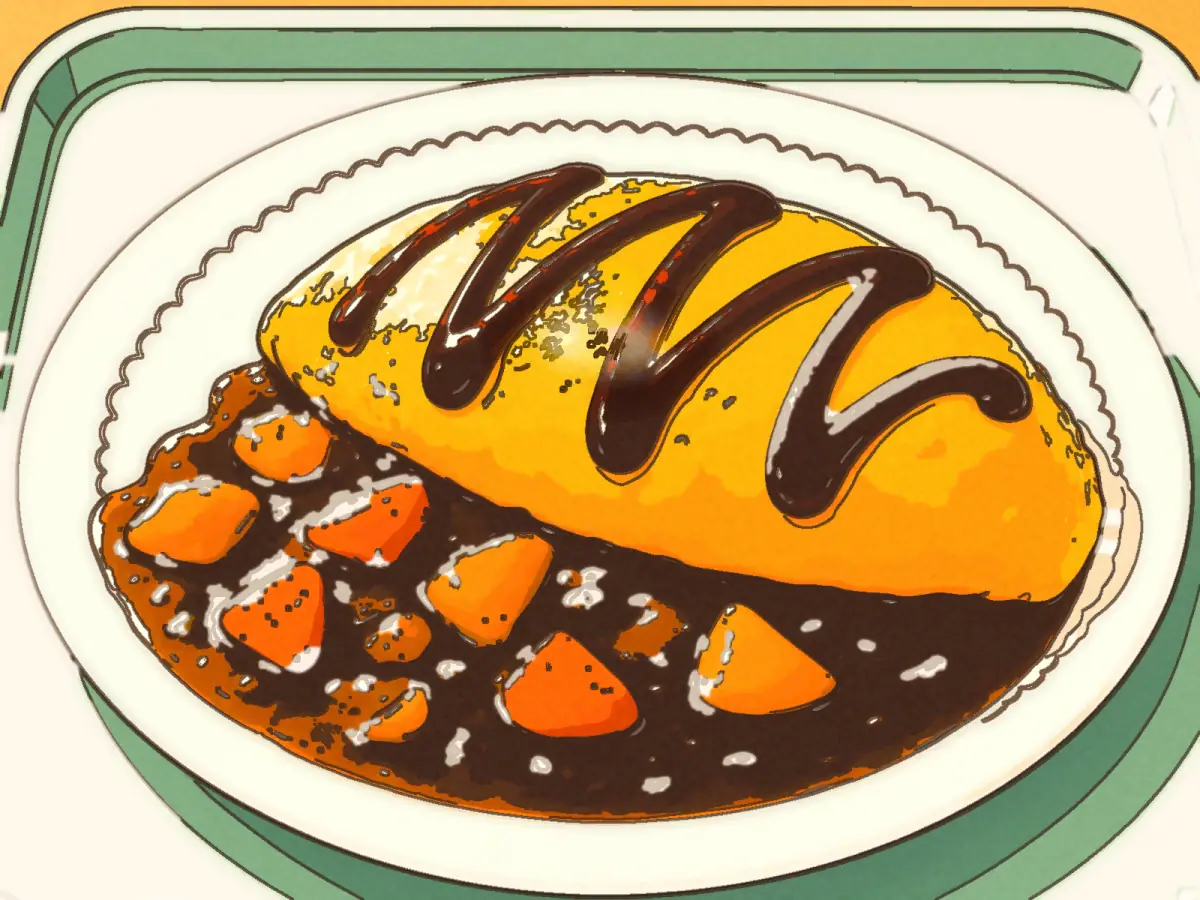
In the preliminaries of a big school tournament, an omurice is served with a fragrant curry risotto hidden inside.
Un omurice espectacular de concurso; sin spoilers de puntuaciones.
Food Wars Curry Risotto Omurice
Creamy curry risotto wrapped in a thin omelette, with a glossy sauce. Omurice is the Japanese omelette-wrapped rice dish.
approx. 760 kcal · Sunday spread
1 h · base recipe for 2 servings
Food Wars Curry Risotto Omurice
Ingredients
- 160 g rice (uncooked)
- 600 ml chicken stock
- 80 g onion
- 50 g carrot
- 10 g curry powder
- 20 g butter
- 40 ml cream
- 50 g diced mango (or apple)
- 10 g honey
- 4 eggs (220 g)
- 15 ml oil
- 30 g ketchup
- 10 ml soy sauce
Get ready
- Wash your hands, and again after touching the raw eggs.
- Measure the stock, cream, oil, ketchup, soy sauce, honey, curry powder and rice.
- Peel the onion and carrot, and wash the mango or apple.
- Take out the 4 eggs and put 2 in each bowl: these are the two omelettes.
- Have two warm dinner plates and paper towels for greasing the pan ready.
Tools
- Saucepan for the stock
- Wide, heavy-based casserole
- 22 to 24 cm nonstick frying pan
- Cutting board and chef's knife
- Two bowls and a fork
- Small saucepan for the sauce
- Wooden spoon and flexible spatula
- Ladle
- Kitchen scale and measuring cup
- Paper towels
Steps
- Pour the chicken stock (600 ml) into a saucepan and warm it over low heat. It should steam without boiling hard; you'll add it hot, a little at a time.If you add cold stock, the rice stops cooking with each ladle and ends up hard on the outside.
- Halve the onion and dice each half into a 3 mm brunoise: thin lengthwise cuts, one cut across, then small cubes.Claw grip with your holding hand (knuckles forward) and a pinch grip on the knife: thumb and index finger hold the blade.
- Peel the carrot and cut it into 3 mm thick sticks. Gather the sticks and cut them into 3 mm cubes (brunoise).Cut a flat side on the carrot first so it doesn't roll.
- Cut the mango into 5 mm cubes, or the apple if you don't have mango. Set them aside on a small plate.
- Melt the butter in the wide casserole over medium heat, until it foams without browning.If the butter starts to smell nutty and darken, lower the heat: here it should stay pale.
- Add the onion and carrot and soften them over medium-low heat for 6 to 7 minutes, stirring, until the onion is translucent and soft, without browning.
- Sprinkle in the curry powder and stir for 30 seconds, until it smells of toasted spices. Don't leave it longer or it will turn bitter.
- Add the uncooked, unwashed rice and stir for 2 minutes over medium heat, until the grains are glossy and translucent at the edges.Don't wash the rice: the starch on the surface is what makes it creamy.
- Pour in a ladle of hot stock (about 120 ml) and stir over medium-low heat until the rice has absorbed almost all the liquid and you can see the bottom of the pan when you drag the spoon through.
- Keep adding stock, one ladle at a time, stirring over medium-low heat. Wait for each addition to be absorbed before adding the next: about 18 to 20 minutes in total.Stir vigorously, especially toward the end: that releases the starch and the creaminess appears by itself.
- Taste a grain. It should be creamy outside and tender with a slightly firm center, with no raw taste. If not, add one last ladle of stock and cook for 2 more minutes.
- Take the casserole off the heat. Stir in the cream (40 ml) and honey (10 g) until the risotto is glossy and loose, like a thick cream.
- Add the diced mango, fold it in gently and cover to keep the risotto hot while you make the omelettes.The mango only needs to warm through: if it boils, it falls apart.
- Beat two eggs in each bowl with a fork for 30 seconds, until no strands of white remain. Don't add extra salt: the risotto is already seasoned.For a smooth omelette, pass the beaten egg through a fine sieve.
- Heat the nonstick frying pan over medium heat and grease it with half the oil (7 ml), spreading it with paper towel so only a thin film is left.
- Pour the first bowl of egg into the pan and tilt it to spread it into a thin disc. Cook over medium-low heat for 1 to 1½ minutes, until the surface is almost dry but still glossy.The egg should be set, with no clear runny white, but not browned.
- Slide the omelette onto a warm plate. Grease the pan with the rest of the oil (7 ml) and repeat with the second bowl.
- Divide the risotto into two mounds and shape each into an oval about 14 cm long on top of each omelette, using a spatula.Wet the spatula so the rice doesn't stick.
- Fold the sides of each omelette over the risotto to cover it and flip it on the plate so the seam is underneath.
- Put the ketchup (30 g) and soy sauce (10 ml) in a small saucepan and warm over low heat for 1 to 2 minutes, stirring, until gently bubbling and glossy.
- Drizzle the sauce in a zigzag over each omurice and serve right away, while the risotto is hot.So the omelette doesn't go cold, don't leave the plates waiting.
Allergens
Contains: gluten, huevo, soja, lácteos.
May contain: apio, mostaza.
A guide only; always check the label.
Per serving, approx.
Energy · 760 kcal
Week menu
Put this dish on a lunch or a dinner. The combined list adds up the whole menu.
Notes
El agua de la masa de garbanzo: en la versión vegana, los 120 ml de agua van dentro del ingrediente «60 g de harina de garbanzo + 120 ml de agua». Para el resto no se añade agua.
Versión original: el aceite (15 ml) se reparte en 7 ml + 7 ml para engrasar las dos tortillas; la mantequilla y la nata van al sofrito y al final del risotto, respectivamente. Los huevos van solo en la tortilla.
Versión ligera: la ficha no trae soja ni zanahoria, así que la salsa es solo kétchup caliente y el volumen lo da el calabacín. Los 10 g de aceite se reparten 5 g para el sofrito y 2,5 g + 2,5 g para las dos tortillas. Se hace un solo bol con las 3 claras y el huevo y se divide en dos.
Versión sin gluten: hay que comprobar el sello del caldo, del curry, del tamari y del kétchup. La ficha solo lo indica para curry, caldo y tamari; el kétchup se menciona como consejo.
Versión vegana: sin mantequilla, nata, miel, huevo ni caldo de pollo. Las crepes de garbanzo llevan solo harina y agua según la ficha, sin sal añadida. Los 20 ml de aceite se reparten 10 ml para el sofrito y 5 ml + 5 ml para las crepes.
Passport
Mark it when you cook it. If you upload a photo, the stamp is sealed.
In other kitchens
No notes yet. The first one can be yours.