
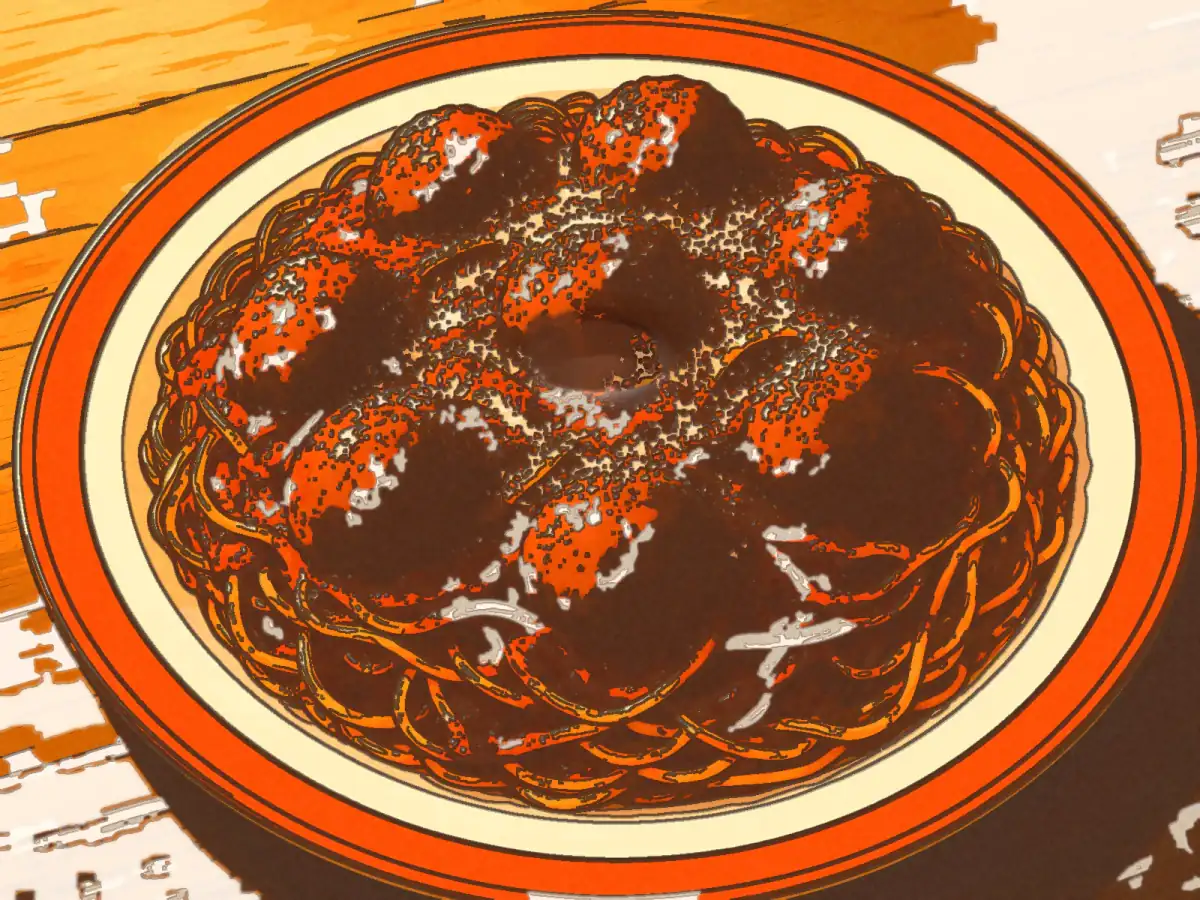
After a chase, two partners share a huge plate of spaghetti and meatballs at a tavern and race each other to finish it.
Una ración generosa de pasta en una taberna; sin spoilers del golpe.
Cagliostro Spaghetti and Meatballs
Al dente pasta with juicy meatballs in tomato sauce: a plate for sharing (or for racing).
approx. 900 kcal · Sunday spread
1 h · base recipe for 2 servings
Cagliostro Spaghetti and Meatballs
Ingredients
- 200 g dried spaghetti
- 250 g mixed ground meat (beef + pork)
- 30 g dried breadcrumbs
- 1 egg (55 g)
- 30 g grated onion
- 400 g crushed tomatoes
- 20 ml oil
- 10 g garlic
- 5 g salt
- 5 g sugar
- 10 g cheese (optional, for serving)
- Water, as needed (for cooking the pasta)
Get ready
- Wash your hands with warm water and soap. Wash them again every time you touch the raw meat or the egg in its shell.
- Take the ground meat out of the fridge 10 minutes ahead so it isn't ice-cold when you mix it (it's still fresh: don't leave it out for more than 2 hours).
- Measure the breadcrumbs, oil, crushed tomatoes, sugar and the 5 g of salt. Set aside 2 g of that salt for the meatball mixture and 3 g for the sauce.
- Have a room-temperature egg and a bowl for the shell ready. Get a plate or light tray ready for the 8 meatballs.
- Put a large pot of plenty of water on to heat for the pasta once the meatballs are in the sauce (don't add extra salt, so the card's 5 g stays the same).
- Grate the onion and peel the garlic during your mise en place, or do it in the first steps, whichever you prefer.
Tools
- Large bowl for mixing the meat
- Grater (for the onion and, at the end, the optional cheese)
- Cutting board and chef's knife
- Deep frying pan or wide casserole with a lid
- Large pot and colander for the spaghetti
- Tongs or wooden spoon
- Kitchen scale and measuring spoons
- Plate for the raw meatballs
- Paper towels
- Timer
- Two pasta bowls for serving
Steps
- Peel the onion and grate it on the fine side of the grater until you have 30 g. Squeeze out a little of the excess juice by hand (don't dry it completely: that juice keeps the mixture moist).Grating rather than chopping leaves the onion almost melted into the meatball, with no crunchy bits.
- Peel the 10 g of garlic (about 2 or 3 cloves). Crush each clove with the flat of the knife and chop it into a very fine 1 to 2 mm brunoise, using the claw grip.Finely chopped garlic melts into the oil and perfumes the sauce without leaving big pieces.
- In a large bowl, combine the mixed ground meat, the breadcrumbs, the egg (crack it into a glass first to check it's good), the grated onion and 2 g of salt. Wash your hands after touching the shell.If the egg smells odd when you crack it or the white looks pink, throw it away and don't use it.
- Mix with a clean hand or a fork, using short movements, until everything is combined and the mixture is even, with no streaks of dry breadcrumbs. Don't knead it like bread: stop as soon as it comes together.Overworking makes the meatballs dense and dry. The mixture should be sticky and moist, not an elastic paste.
- Divide the mixture into 8 equal portions (about 40–45 g each). Wet your palms with a little water and roll smooth balls with no cracks, rolling gently. Place them on a plate.Wet hands stop the meat from sticking and keep you from squashing the balls as you shape them.
- Heat a deep frying pan over medium-high heat and add the 20 ml of oil. It's ready when the oil shimmers and a crumb of meat sizzles on contact, without smoking.If it smokes, take the pan off the heat for a few seconds and lower to medium heat.
- Brown the meatballs for 6 to 8 minutes in total, turning them with tongs every 1 or 2 minutes, until golden almost all over. Don't pierce them with a fork.They don't need to be cooked through yet: they finish in the sauce. If they stick at first, wait a few seconds: they release once they brown.
- Move the meatballs to a clean plate. In the same pan, lower to medium heat and fry the garlic for 30 to 45 seconds, until fragrant and just golden at the edges, without turning dark brown.Burnt garlic makes the whole sauce bitter: if it gets too dark, take it out and start that part again (the card's amount hasn't been changed).
- Pour in the crushed tomatoes, the sugar and the remaining 3 g of salt. Stir and wait for a gentle simmer, with slow bubbles on the surface.The sugar rounds off the tomatoes' acidity; it isn't meant to make the sauce sweet.
- Return the meatballs to the sauce, cover and cook for 20 minutes over medium-low heat. The sauce should tremble, not spatter. They're done when the center of one is no longer pink when you break it open and the juices run clear (or it reaches about 71 °C: it's ground meat).Turn them halfway through so they soak up sauce all around. If the sauce reduces too much, lower the heat; don't add extra water.
- Meanwhile, bring a pot of plenty of water to a rolling boil (high heat, big, constant bubbles). When it boils, add the spaghetti and cook for 1 minute less than the time on the package, stirring at the start so it doesn't stick.You can tell al dente by biting: the center gives a tiny bit of resistance, with no raw white thread.
- Drain the pasta (save half a ladle of the cooking water in case the sauce is very thick) and toss it in the frying pan with the sauce and meatballs for 1 minute over medium-low heat, until every strand is coated in red.If it needs more juiciness, add a splash of that pasta water: its starch helps the sauce cling.
- Serve in two pasta bowls, with the meatballs on top. If you like, grate the optional cheese over the top.The cheese is optional, as the card already says. Anyone who doesn't want it can leave it off when serving.
Allergens
Contains: gluten, huevo, lácteos.
May contain: soja.
A guide only; always check the label.
Per serving, approx.
Energy · 900 kcal
Week menu
Put this dish on a lunch or a dinner. The combined list adds up the whole menu.
Notes
El agua de cocción de la pasta figura ahora como línea de ingredientes; no se ha añadido sal extra al agua para no alterar la sal de cada ficha.
Versión original: de los 5 g de sal, 2 g van a la mezcla y 3 g a la salsa, como en el método aprobado («2 g de sal» en la masa).
Versión ligera: no lleva azúcar ni queso. El calabacín se corta en fideos y se saltea aparte.
Versión vegana: las albóndigas son de alubias cocidas, como indica el título. El ajo de la ficha se reparte entre masa y salsa, sin cambiar la cantidad.
Passport
Mark it when you cook it. If you upload a photo, the stamp is sealed.
In other kitchens
No notes yet. The first one can be yours.