
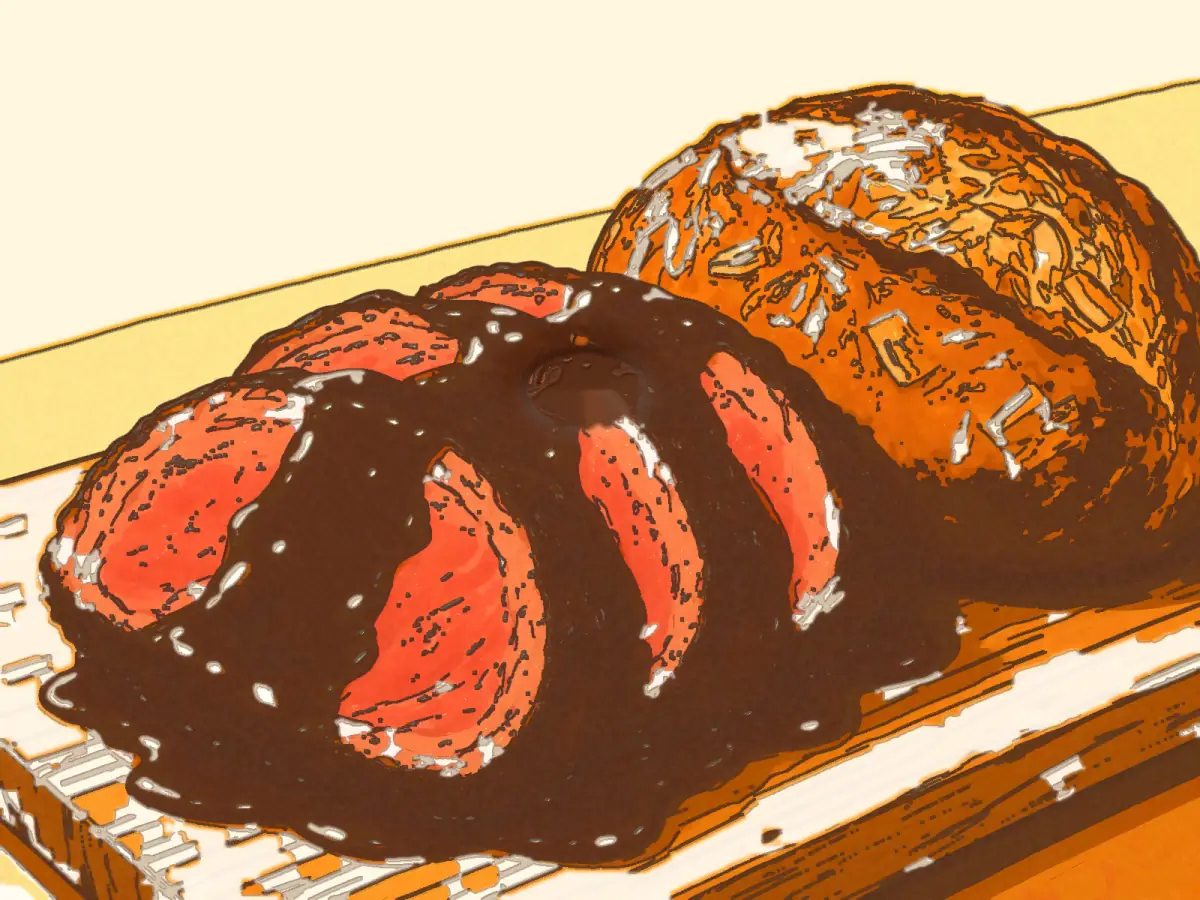
After defeating the red dragon, the party uses its meat to cook a menu of roast, tail soup and onion bread (chapter 28, episode 12).
Red Dragon Roast with Onion Bread
Beef roasted in red wine with turnips and carrots, plus an onion and cheese flatbread fresh from the oven: a celebration feast after the big battle.
approx. 635 kcal · midday plate
2 h (40 min activos) · base recipe for 4 servings
Red Dragon Roast with Onion Bread
Roast
- 800 g beef eye of round roast
- 150 ml red wine
- 400 g turnips and 200 g carrots, in chunks
- 150 g onion and 10 g garlic
- 20 ml olive oil
- 5 g salt, pepper and rosemary
Onion bread
- 200 g bread flour
- 130 ml lukewarm water and 3 g dried baker's yeast
- 3 g salt and 10 ml oil
- 150 g onion, in thin rings
- 80 g grated mozzarella
Get ready
- Wash your hands with warm water and soap. Wash them again every time you touch the raw meat, and don't use the same board for the bread or vegetables without washing it.
- Take the beef roast out of the fridge 20–30 minutes ahead, so it isn't ice-cold when you brown it.
- Measure into separate bowls: 130 ml of lukewarm water (about 35–38 °C: it should feel warm, not burn your finger) with the 3 g of yeast; 200 g of flour; 3 g of salt and 10 ml of oil for the dough; 150 ml of red wine.
- Grate or have ready the mozzarella (80 g), and keep the onion for the bread separate from the onion for the roast so the quantities don't get mixed up.
- Preheat the oven to 180 °C (350 °F) once the dough is already rising, so it isn't on for longer than needed.
- Pat a sprig of rosemary dry if you are using fresh, and keep pepper next to the 5 g of salt for the roast.
Tools
- Large bowl for the dough
- Clean dish towel or plastic wrap for covering
- Kitchen scale and measuring cup
- Flameproof, ovenproof tray or casserole
- Kitchen tongs
- Kitchen thermometer (highly recommended for the center of the meat)
- Aluminum foil or a lid, for resting the meat
- Rolling pin
- Baking paper
- Board and chef's knife (one board for the raw meat and another clean one for the vegetables and bread)
- Wire rack and oven gloves
Steps
- In a bowl, mix the 200 g of bread flour with the lukewarm water and the 3 g of dried yeast. Add the 3 g of salt and the 10 ml of oil for the dough and stir with a spoon until there's no dry flour left.The water should not go above about 40 °C: any hotter and the yeast dies and the dough won't rise. If it's cold, it will take longer to get going.
- Knead for 8 minutes on a lightly floured worktop: push with the heel of your hand, fold and turn. It's ready when it turns smooth and elastic and no longer sticks too much to your hands.If it's very sticky, wait a minute (the gluten relaxes) before adding another dusting of flour. Don't drown the dough in extra flour.
- Shape it into a ball, put it in the bowl, cover with a dish towel and leave it to rise for 1 hour somewhere warm, until it has doubled in size and a gentle poke springs back slowly.The oven switched off with just the light on is usually a good warm spot.
- Pat the beef roast dry with paper towels on every side, including underneath.A dry surface browns; a damp one stews and won't take on color.
- Season the roast on every side with the 5 g of salt, pepper and rosemary, pressing the herbs in a little so they stick.Don't pierce the roast with a fork: the juices would escape while browning.
- Heat a flameproof, ovenproof casserole or tray over medium-high heat with the 20 ml of olive oil. The oil is ready when it shimmers and a corner of the meat sizzles when it touches it.If the oil smokes heavily, take it off the heat for a moment and turn down to medium.
- Brown the roast on every side, including the ends, for about 8 minutes in total. Turn it with tongs every 1 or 2 minutes. It's ready when it has a brown crust and smells of seared meat, not burning.Don't pierce it. If it sticks at first, wait a few seconds: once browned it releases by itself.
- Peel the 400 g of turnips and the 200 g of carrots and cut them into 3–4 cm chunks. Peel the 150 g of onion and cut it into thick wedges. Crush the 10 g of garlic with the flat of the knife and leave the cloves whole. Use the claw grip, with your fingertips tucked behind your knuckles.Big chunks survive an hour in the oven without turning to mush.
- Arrange the turnips, carrots, onion and garlic around the meat, turning the vegetables a little in the juices at the bottom.The vegetables should be in a single layer, not piled on top of the meat.
- Pour in the 150 ml of red wine, scraping the bottom with a wooden spoon to lift the browned bits.Those browned bits are the flavor of the sauce: don't leave them stuck and burnt.
- Put the casserole in the oven at 180 °C (350 °F) for 50 to 60 minutes. The approved doneness for this card is a pink center, about 57 °C when you push the thermometer into the thickest part without touching the tray. The juices should look pink, not a cold raw red.The eye of round is a whole roast, not ground meat: 57 °C leaves the center pink, as the recipe calls for. If you prefer your meat more cooked, take it to 63–65 °C; the roast will be less pink and a little firmer. Don't leave the center cold or raw.
- Transfer the meat to a clean board, cover it loosely with foil or a lid and let it rest for 15 minutes. Leave the vegetables and juices in the casserole, covered so they don't go cold.If you carve it straight away, the juice runs out and the slices end up dry.
- Turn the oven up to 230 °C (450 °F). Meanwhile, peel the 150 g of onion for the bread and cut it into thin 2–3 mm rings, using the claw grip.Thin rings roast in 12–15 minutes; thick ones stay raw inside.
- Roll the dough out into a thin oval about 3–4 mm thick on baking paper. If it shrinks back, let it rest for 3 minutes and roll again.A thin oval cooks through underneath and turns crisp; if it's thick, the center stays doughy.
- Top the dough with the onion rings and the 80 g of grated mozzarella, leaving a clean 1 cm border so the cheese doesn't spill over.Don't overload the center: an even layer browns better.
- Bake the bread at 230 °C (450 °F) for 12 to 15 minutes, until the edge is golden, the base sounds hollow when tapped underneath and the cheese is bubbling with toasted spots.If the cheese browns before the base, move the tray down a shelf.
- Slice the meat thinly, 4–6 mm, against the grain (across the fibres, which look like long lines).A long knife and a gentle sawing motion keep the rested roast from tearing.
- Serve the slices with the vegetables and juices from the casserole, and cut the bread into pieces to go alongside.If the juices have reduced too much, warm them for a few seconds over low heat; don't add any water that isn't on the card.
Allergens
Contains: gluten, lácteos, sulfitos.
A guide only; always check the label.
Sin verificar. Adaptación propia: la carne de dragón se sustituye por ternera. Se incluyen el asado y el pan de cebolla; la sopa de cola se omite para mantener un plato manejable.
Per serving, approx.
Energy · 635 kcal
Week menu
Put this dish on a lunch or a dinner. The combined list adds up the whole menu.
Notes
El punto rosado a unos 57 °C en el centro es el de la ficha aprobada para una pieza entera de redondo. Quien prefiera la carne más hecha puede llegar a 63–65 °C. No se ha cambiado el tiempo ni la temperatura de la ficha.
El agua de la masa ya figuraba en las líneas de ingredientes. El agua para blanquear la coliflor vegana figura ahora como línea de ingredientes.
En las versiones con líneas agrupadas (sin gluten y vegana) se usan los nombres exactos de la ficha aunque reúnan varios alimentos.
La mozzarella de la versión sin gluten debe ir sin almidón de trigo, como indica la ficha.
Passport
Mark it when you cook it. If you upload a photo, the stamp is sealed.
In other kitchens
No notes yet. The first one can be yours.