
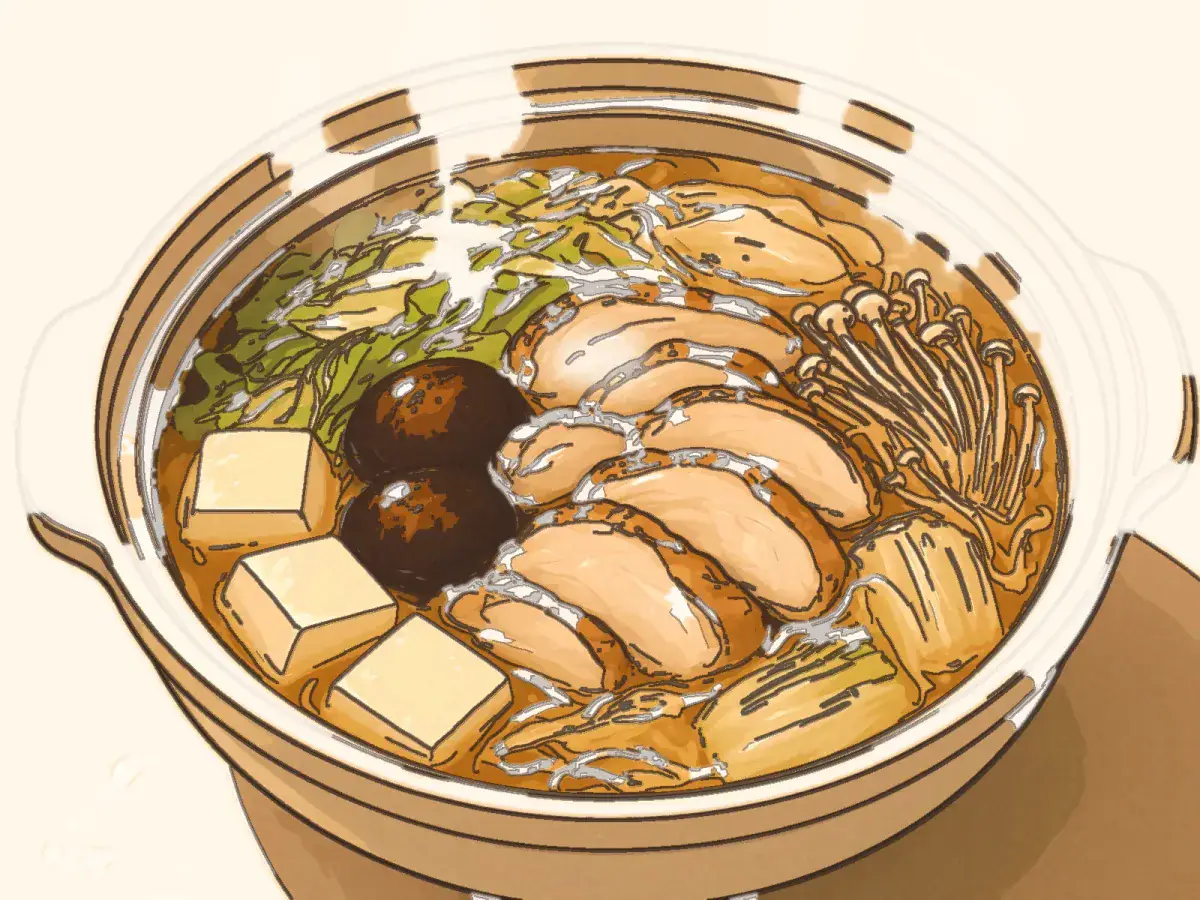
It's the first dish cooked in the series (chapter 1 of the manga and episode 1 of the anime): a mizutaki, a hotpot simmered in water, made with a huge scorpion and a walking mushroom. Here we adapt it with real ingredients: shrimp instead of scorpion, king oyster mushrooms instead of walking mushroom, potato instead of the dungeon tuber, and seaweed and glass noodles instead of dried slime.
Dungeon Mizutaki (Huge Scorpion and Walking Mushroom)
A steaming pot of clear broth with shrimp, meaty mushrooms, potato and glass noodles, set in the middle of the table to share after a long expedition. Mizutaki is a Japanese hotpot simmered in a light, clear broth.
approx. 320 kcal · light bite
50 min · base recipe for 4 servings
Dungeon Mizutaki (Huge Scorpion and Walking Mushroom)
Ingredients
- 800 g raw shell-on shrimp (prawn) (≈400 g peeled)
- 300 g king oyster mushrooms (eryngii), in thick strips
- 150 g fresh shiitake mushrooms
- 500 g potatoes, in 3 cm chunks
- 10 g kombu seaweed
- 6 g dried wakame seaweed
- 100 g glass noodles (mung bean)
- 1.6 l water
- 30 ml soy sauce and 2 g salt
Dipping sauce
- 40 ml lemon juice and 30 ml soy sauce
- Water, as needed (for soaking the wakame and glass noodles)
Get ready
- Wash your hands before and after touching the raw shrimp. Use one board just for raw seafood and another clean one for vegetables.
- Measure the 1.6 l of cold water into the pot. Have two bowls ready: one for the heads and shells, another for the peeled bodies.
- Set aside 30 ml of soy sauce for the broth and 30 ml for the dipping sauce (plus the lemon). Keep the salt aside.
- Get a strainer ready, a bowl of cold water for the wakame and another with hot water for the glass noodles.
Tools
- Large pot (3–4 liters) with lid
- Two cutting boards (raw seafood / vegetables)
- Chef's knife and peeler
- Fine-mesh strainer
- Two bowls for soaking the wakame and noodles
- Small bowls for the dipping sauce
- Wooden spoon, tongs, citrus juicer, kitchen scale and timer
- Spoon for pressing the heads
Steps
- Peel the shrimp, leaving the tail on: pull off the head and the shell of the body, but keep the tail fan in place (it looks nicer and holds together better). Keep all the heads and shells in a bowl. On each body, make a shallow cut along the back and remove the dark vein with the tip of the knife. Wash your hands and switch boards.The vein isn't poisonous, but it tastes bitter and clouds the broth if it breaks. If a shrimp smells strongly of ammonia, throw it away.
- Cut the king oyster mushrooms into thick strips 1 to 1.5 cm wide, along the stem, so they look like meaty fillets. Keep your fingers in a claw grip.Don't chop them finely: they should feel like a dungeon ingredient, with some bite.
- Clean the fresh shiitake with a damp cloth (don't soak them). Trim the stem if it's very tough and, if they're large, cut them in half; leave small ones whole.
- Peel the potatoes and cut them into rough chunks of about 3 cm. Keep them in cold water if you're taking a while so they don't discolor, and drain them before adding them to the broth.Smaller pieces fall apart; larger ones won't cook in 12 minutes.
- Squeeze the lemon until you have 40 ml of juice (strain out the seeds) and mix it with 30 ml of soy sauce in one bowl or four small dishes. Set the dipping sauce aside.
- Put the kombu in the 1.6 l of cold water and leave it to soak for 20 minutes. The water will take on a faint tint and the seaweed will soften.
- Heat over medium heat and remove the kombu just before it boils, when small bubbles rise around the edge.If it boils with the kombu in, the broth turns slimy and a little bitter.
- Add the shrimp heads and shells. Simmer for 10 minutes over low heat (a lazy bubble, not a hard boil) and, now and then, press the heads with the back of a spoon so they release their roe and flavor.A hard boil clouds the broth and makes it bitter.
- Strain the broth through a fine-mesh strainer into another pot or a large bowl, without pressing the shells too hard (pressing releases bitter sediment). Discard the solids and return the clear broth to the pot.
- Add the drained potatoes and cook them for 12 minutes over medium heat, until a knife goes in with little resistance but the chunk doesn't fall apart.
- Add the king oyster mushrooms and shiitake and cook for 5 more minutes. The mushrooms should look glossy and soft, not rubbery or raw in the middle of the stem.
- Season with the 30 ml of soy sauce and 2 g of salt. Taste: the broth should be clean, tasting of the sea and gentle, not salty like a packet soup.
- Meanwhile, soak the wakame for 5 minutes in a bowl of cold water, until it opens up and turns soft, then drain. In another bowl, cover the glass noodles with hot water (it doesn't have to be boiling) for 10 minutes, until they are clear and springy, then drain.If the noodles soak too long, they break when you serve them; test them at 8 minutes.
- Add the shrimp bodies, the wakame and the noodles. Cook for 2 to 3 minutes over medium heat, just until the shrimp turn pink and fully opaque (along the back too, where the vein was) and curl into a C, not a tight circle (that would mean they're overcooked).Don't leave them any longer: they turn rubbery. Wash your hands if you've touched them raw again.
- Bring the pot to the middle of the table (on a trivet or a low burner) and serve with the lemon and soy dipping sauce for each bite. Remember to leave a little broth in the pot in case anyone wants seconds.The broth is still hot: warn everyone at the table. Those who want more tang can dip; those who prefer the clean broth can eat it without sauce.
Allergens
Contains: gluten, crustáceos, soja.
A guide only; always check the label.
Deja parte del caldo. En este plato, alrededor del 50 % de la sal está en el caldo (salsa de soja, miso, sal o caldo). Si te lo tomas todo, la ración aporta unos 3,4 g de sal (aprox.); si dejas en el cuenco un tercio del caldo, baja a unos 2,8 g (aprox.). Como referencia, la OMS recomienda no pasar de 5 g de sal al día en adultos. Disfruta de todo lo sólido y bebe el caldo a sorbitos, sin prisa.
Per serving, approx.
Energy · 320 kcal
Week menu
Put this dish on a lunch or a dinner. The combined list adds up the whole menu.
Notes
El agua de hidratar wakame y fideos de cristal figura ahora como línea propia y no es la de la olla (1,6 l).
Langostinos listos cuando están rosados, opacos por completo y curvados en C. Lávate las manos tras tocarlos crudos.
En la ligera, la col china se divide en tallo blanco y hojas verdes porque el método aprobado los añade en momentos distintos.
En la vegana, las shiitake secas viajan en la misma línea que las frescas.
Passport
Mark it when you cook it. If you upload a photo, the stamp is sealed.
In other kitchens
No notes yet. The first one can be yours.