
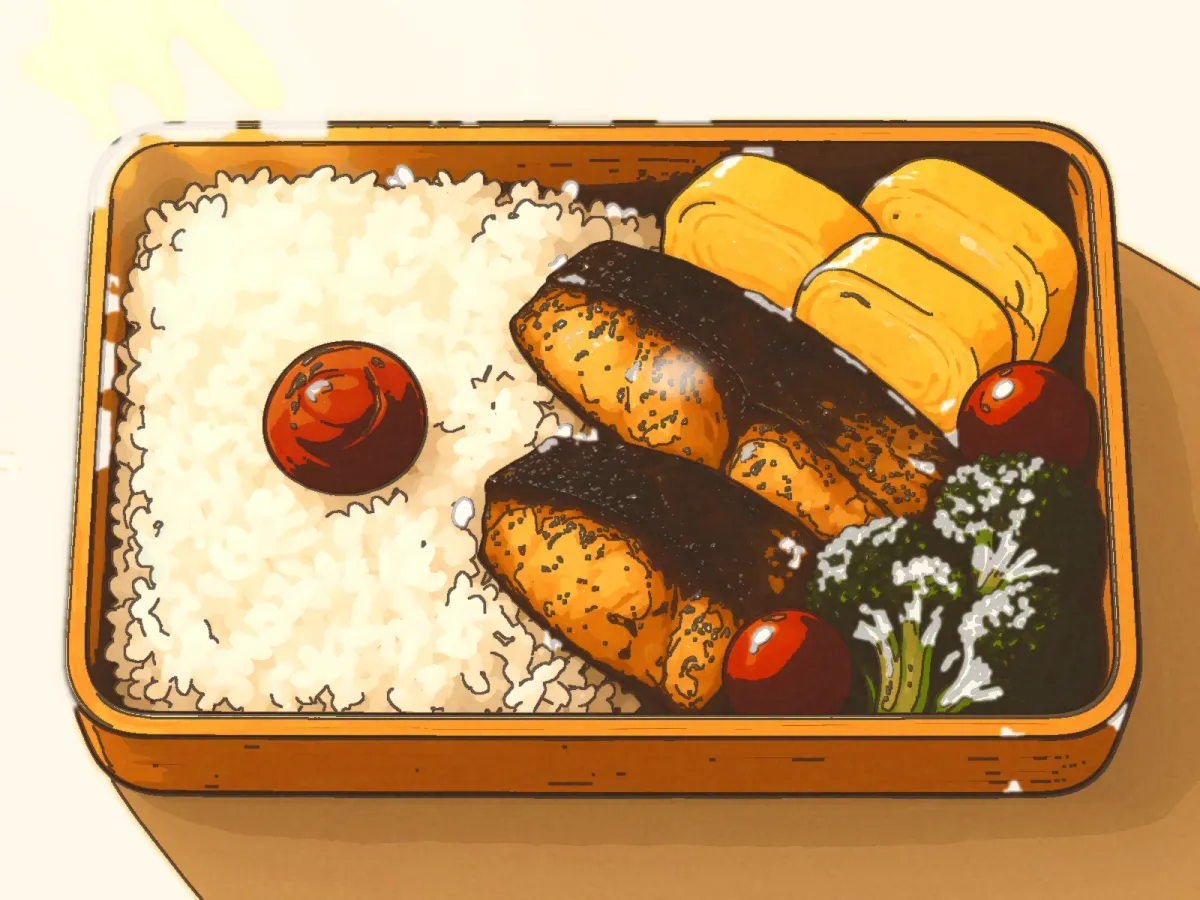
In the film, Satsuki gets up before dawn to pack three lunch boxes with rice, a pickled plum, a little fish and pink fish flakes for her father, her sister Mei and herself.
Satsuki's Bento
A lunch box of white rice with a red pickled plum in the center, a little grilled sardine, pink hake flakes and green edamame: food made with love to take along.
approx. 460 kcal · midday plate
45 min · base recipe for 3 servings
Satsuki's Bento
Ingredients
- 240 g short-grain or Japanese rice
- 310 ml water for cooking the rice
- 3 umeboshi (salted pickled plums; 30 g; from Asian shops)
- 3 small sardines, cleaned (150 g cleaned)
Pink flakes (homemade sakura denbu)
- 120 g fresh hake or cod, skinless and boneless
- 15 g sugar, 10 ml mirin and 1 g salt
- 10 ml cooked beet juice (beetroot juice) (beet juice (beetroot juice))
Green
- 90 g shelled edamame (or peas)
- Water, as needed (for cooking the hake and the edamame)
Get ready
- Wash your hands with warm water and soap. Wash them again every time you touch raw fish.
- Measure 240 g of rice and have 310 ml of water ready to cook it.
- If the edamame is frozen, there's no need to thaw it completely; if you're using peas, have them ready the same way.
- Prepare 10 ml of cooked beet juice (blend a piece and strain it, or use the liquid from plain cooked beet).
- Have three clean, dry lunch boxes ready, and a spot where the bentos can cool uncovered.
- Use one board for the raw fish and another clean one for assembling.
Tools
- Saucepan or rice cooker, and a sieve for the rice
- Saucepan for the fish or the edamame
- Non-stick frying pan
- Fork and paper towels
- Several chopsticks or a wooden spatula
- Griddle or frying pan for the sardines
- Tongs
- Three lunch boxes
- Board and knife
- Kitchen scale and measuring cup
- Timer
Steps
- Put the 240 g of rice in a sieve and wash it under cold running water, stirring with your hand, until the water runs almost clear. Let it drain for 2 minutes.The first water comes out milky from the starch: if you don't wash it, the rice turns gluey and won't separate in the lunch box.
- Transfer the rice to a saucepan with 310 ml of cold water. Cover, bring to the boil over medium-high heat (you'll see steam and bubbles at the edge) and, as soon as it boils, turn down to low heat and cook for 12 minutes without lifting the lid.Don't lift the lid: the steam escapes and the grains stay hard in the middle.
- Turn off the heat and let the rice rest for 10 minutes, still covered. Then uncover and fluff it with a paddle, using cutting motions, without squashing.Resting finishes cooking the center of the grain with the remaining steam.
- Meanwhile, cover the hake or cod with cold water in a saucepan (the water is just the cooking medium). Bring it to a gentle simmer over medium heat and cook for 5 minutes, until the flesh turns opaque and flakes when you touch it with a fork.The fish is done when it separates into flakes and no longer looks translucent or raw in the center.
- Drain the hake and shred it very finely with a fork, first in the sieve and then between two sheets of paper towel, pressing to squeeze out as much water as possible.If it stays damp, the flakes won't dry in the pan and will clump instead of staying loose.
- Put the shreds in a non-stick frying pan with the sugar, mirin, salt and beet juice. Stir over low heat with several chopsticks or a spatula for 10 to 12 minutes.The heat must be low: if it toasts, it turns bitter and loses its pink. The chopsticks separate the strands as if you were combing them.
- Keep stirring until the flakes are dry to the touch, loose (not a paste) and evenly pink. Turn off the heat and set them aside to cool.They're ready when they part under the chopsticks like damp sand that no longer drips.
- Heat a griddle or frying pan over medium-high heat. When you feel a clear heat as you hold your hand above it, add the 3 cleaned sardines and grill them for 2 to 3 minutes per side.They're ready when the skin is marked and toasted silver, the flesh turns opaque and comes away a little from the backbone. The fish must not be raw or translucent next to the bone.
- Cook the shelled edamame (or peas) for 4 minutes in gently simmering water, until tender and bright green. Drain and, if you like, pat it dry with a dish towel so it doesn't wet the rice.A dull green and a mushy texture mean it's overcooked.
- Share the still-warm rice between three lunch boxes, without packing it down too much, and place an umeboshi in the center of each one, pressed in a little so it tints the rice pink.Warm rice is easier to shape and won't steam up the lid if you then let it cool uncovered.
- Lay a sardine across the rice in each lunch box and, to one side, add a little pile of pink flakes and another of edamame.Leave a small gap between the fish and the flakes so the colors don't run into each other too much.
- Let the lunch boxes cool uncovered at room temperature until the rice feels lukewarm or cold to the touch. Then close them. Don't leave them out for more than 2 hours in hot weather; if they won't be eaten soon, put them in the fridge.Closing them while hot creates steam, softens the fish and can turn the rice sour.
Allergens
Contains: pescado, soja.
May contain: gluten, sulfitos.
A guide only; always check the label.
Sin verificar. El tipo exacto de pescado varía según la fuente (mezashi o shishamo, pescaditos secos o asados); aquí se usan sardinas pequeñas, fáciles de encontrar.
Aviso. Sal: cada umeboshi aporta por sí sola casi 2 g de sal aprox. Se puede servir media.
Per serving, approx.
Energy · 460 kcal
Week menu
Put this dish on a lunch or a dinner. The combined list adds up the whole menu.
Notes
El agua de cocer el arroz (310 ml para 240 g y 195 ml para 150 g), la de cocer la merluza y el edamame (y el vapor del brócoli ligero) figuran ahora como líneas de ingredientes; las cantidades de la ficha aprobada no cambian. El agua de lavar el arroz no cuenta.
El tipo exacto de pescadito de la escena no está cerrado en las fuentes (mezashi o shishamo); la ficha usa sardinas pequeñas, fáciles de encontrar.
En la versión ligera no hay mirin; el azúcar baja a 8 g. Cada fiambrera lleva media umeboshi (1 y media en total).
En la versión sin gluten hay que usar umeboshi sin aditivos y mirin certificado, como indica la ficha.
Passport
Mark it when you cook it. If you upload a photo, the stamp is sealed.
In other kitchens
No notes yet. The first one can be yours.