
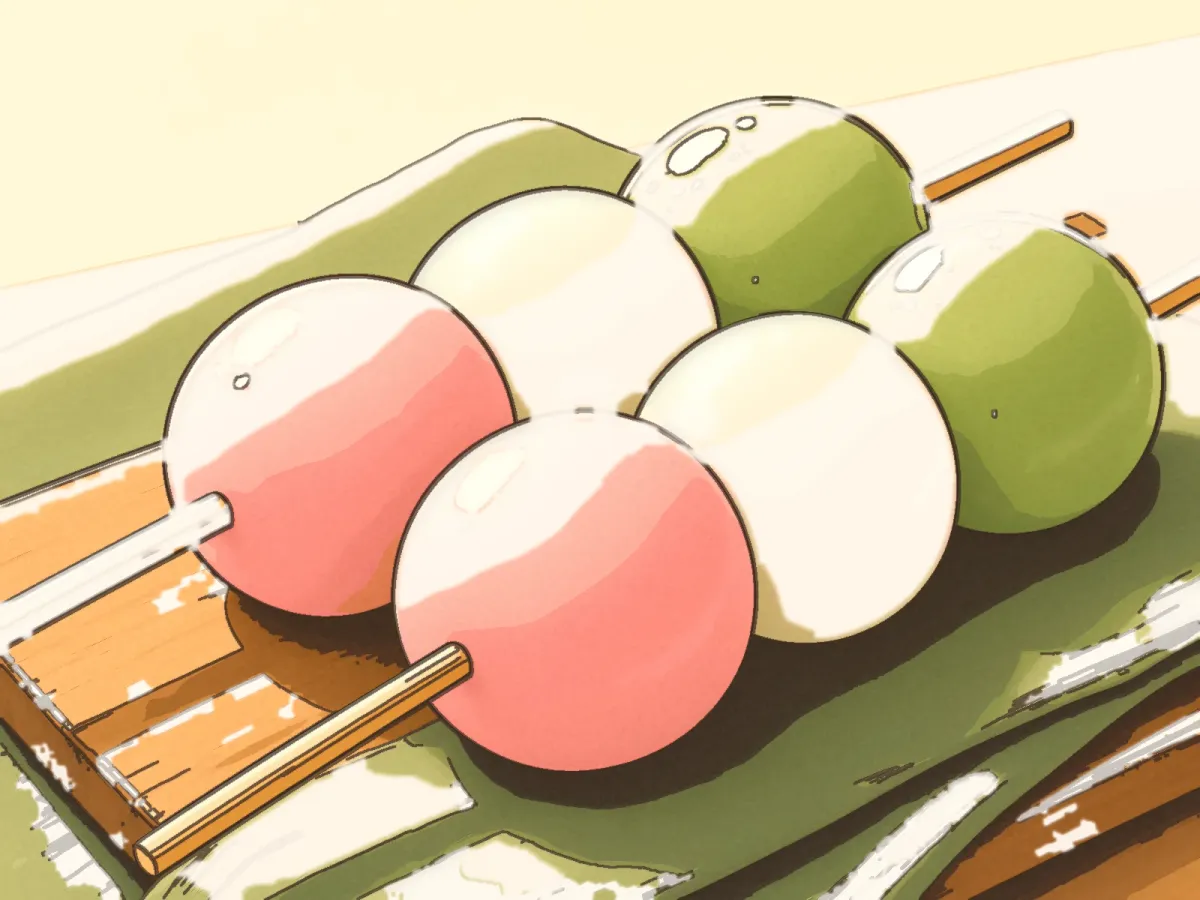
In the series, Itachi and Kisame stop at the Konoha dango shop (episode 81 of the original series); his character profile lists dango as Itachi's favorite sweet.
Konoha Dango Shop Tricolor Dango
Skewers of soft rice dumplings in pink, white and green, sweet and gentle: a little treat to enjoy with hot tea. Dango are chewy Japanese rice-flour dumplings, and this tricolor style is known as hanami dango (cherry-blossom-viewing dango).
approx. 225 kcal · light bite
35 min · base recipe for 4 servings
Konoha Dango Shop Tricolor Dango
Ingredients
- 150 g glutinous rice flour (mochiko or shiratamako; Asian grocery stores)
- 50 g regular rice flour
- 40 g sugar
- About 170 ml warm water
- 2 g matcha powder
- 10 ml cooked beet juice (beetroot juice) (beet juice (beetroot juice)) (for the pink)
- 8 short skewers
- Water, as needed (for boiling and cooling the dumplings)
Get ready
- Wash your hands: you will be kneading and rolling balls with your fingers.
- Measure out both flours and the sugar. Keep the warm water (not cold, not hot: like a comfortable bath) in a small pitcher so you can add it little by little; you may not need the full 170 ml.
- Dissolve the matcha in a few drops of water in a small bowl until you have a smooth green paste with no lumps. Strain the beet juice so there are no bits in it.
- Have 8 short skewers ready (if they are long, cut them and sand or dampen the cut end so there are no splinters). Also set out a bowl of cold water for cooling the dumplings, a wide pot and a slotted spoon.
Tools
- Large bowl and three small bowls
- Kitchen scale and spoon
- Wide pot and slotted spoon or skimmer
- Bowl of cold water
- Tray or plate for the raw dumplings (slightly damp)
- 8 short skewers (listed as an ingredient on this card)
Steps
- In a large bowl, mix both flours and the sugar with a spoon until the color is even and you can no longer see streaks of sugar.
- Add the warm water little by little, first with the spoon and then with your hand, until you have a smooth dough like soft modeling clay that doesn't stick to your fingers or crack when you press it. You may have some water left over: don't pour it all in if the dough already feels right.If it sticks, dust it with a pinch of rice flour; if the balls crack later, it needed a splash more water.
- Divide the dough into three equal portions (use the scale: each one is a third of the total).
- Leave one portion white and untouched. Knead the second with the beet juice, a few drops at a time, until it turns an even pink with no streaks.If the pink dough gets too wet, dust it with a little of the rice flour you set aside when weighing; don't add extra new flour.
- Knead the third portion with the matcha paste until it is an even green, with no dark specks of undissolved tea.Matcha turns bitter if it gathers in one spot: spread it evenly.
- From each color, shape 8 small balls about 2.5 cm across (like a large walnut). Roll them between your palms until smooth, with no cracks. You should have 24 balls in total. Place them on a barely damp plate so they don't dry out.If they crack, smooth them over with a wet finger.
- Bring a wide pot of water to a boil over high heat. Lower it to a steady boil, not a rolling one.If it boils furiously, the dumplings break as they knock into each other.
- Cook the dumplings in batches without crowding them. When they rise to the surface (a sign that the inside is hot and they have become buoyant), count 2 more minutes and lift them out with the slotted spoon.Don't prick them: they deflate. If one hasn't risen after 3–4 minutes, touch it: it should feel springy, not floury in the center.
- Transfer them to a bowl of cold water for 1 minute to stop the cooking and keep them from sticking together. Drain them gently.
- Thread one pink, one white and one green dumpling onto each skewer (the classic order: pink at the bottom or the top, whichever you like, but the same on all eight). Serve them the same day, at room temperature.They harden in the fridge; if you have leftovers, cover them with a damp cloth for a few hours, no more than a day.
Allergens
Contains: the recipe contains none of the 14.
May contain: gluten.
A guide only; always check the label.
Sin verificar. que Itachi o Kisame pidan dango; la fuente solo confirma que paran a tomar té en la tienda de dango. Que el dango tricolor (hanami) sea el que más aparece en esa tienda sí está documentado.
Per serving, approx.
Energy · 225 kcal
Week menu
Put this dish on a lunch or a dinner. The combined list adds up the whole menu.
Notes
El agua de cocción y de enfriado de las bolas figura ahora como línea propia; no es la línea de agua templada de la masa.
En la original, los palillos figuran como ingrediente y se usan al ensartar. En las otras fichas no aparecen en la lista: se tratan como utensilio.
En la ligera, el matcha y el zumo de remolacha van en una sola línea.
Passport
Mark it when you cook it. If you upload a photo, the stamp is sealed.
In other kitchens
No notes yet. The first one can be yours.