
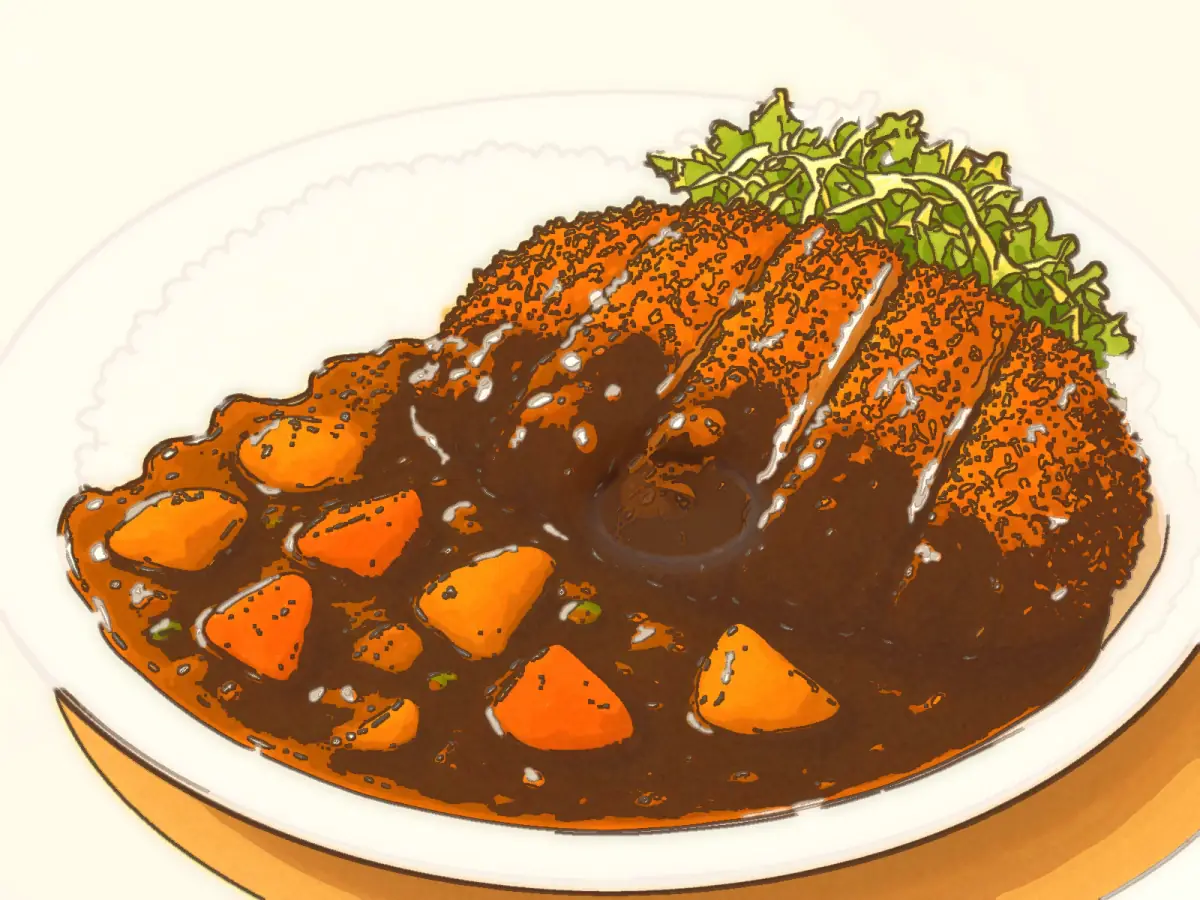
In a filler arc of the original series, Rock Lee is devoted to an extremely spicy curry that he credits with reviving powers (debut in episode 152).
Curry of Life
A thick, very spicy Japanese curry with tender beef, potato and carrot over white rice: it warms you from the inside on training days. Japanese curry is a mild-to-hot, gravy-like stew thickened with a roux (a cooked butter-and-flour paste).
approx. 755 kcal · Sunday spread
2 h (30 min activos) · base recipe for 4 servings
Curry of Life
Ingredients
- 500 g stewing beef (chuck or shin), diced
- 10 ml sunflower oil
- 300 g onion, thinly sliced
- 150 g carrot and 300 g potato, in chunks
- 1 small apple (100 g), grated
- 2 garlic cloves (10 g) and 10 g ginger, grated
- 800 ml homemade unsalted chicken stock
- 15 ml soy sauce and 15 g ketchup
- 3 g salt
For the spicy roux
- 40 g butter
- 40 g wheat flour
- 25 g curry powder and 2–4 g ground cayenne (to taste)
To serve
- 300 g short-grain or Japanese rice
- 390 ml water for cooking the rice
Get ready
- Wash your hands before and after touching the raw beef. Use one board for meat and another for vegetables.
- Take the meat out 15 minutes ahead. If it isn't diced, you'll cut it into 2.5 to 3 cm cubes.
- Measure the stock, the soy sauce and ketchup, the salt, the butter, the flour and the curry powder with the cayenne (start with 2 g if you don't like it very hot; 4 g is properly spicy).
- Measure 390 ml of water for the rice.
- Have a large pot, a frying pan or small saucepan for the roux and a saucepan for the rice ready.
Tools
- Large pot with lid
- Frying pan or small saucepan for the roux
- Saucepan with lid for the rice
- Two cutting boards, knife, peeler, grater
- Wooden spoon, ladle, tongs
- Sieve for the rice, kitchen scale, timer
Steps
- If the beef isn't already cut, dice it into 2.5 to 3 cm cubes, cutting across the grain as much as you can and trimming only the very tough sinew (a little fat adds flavor). Pat the cubes dry with paper towels. Wash your hands.A dry surface browns; a wet one steams and won't take on color.
- Peel the onions and slice them into 3 to 4 mm strips, from root to tip, keeping your fingers in a claw grip.There are 300 g: take your time, thin slices caramelize better.
- Peel the carrot and potato. Cut the carrot into 2 cm pieces (thick rounds or half-moons) and the potato into roughly 2.5 cm cubes. Keep the potato in cold water if you're taking a while, and drain it afterward.
- Peel and grate the apple (without the core). Peel and grate the garlic and ginger. Set aside.The apple melts into the broth and rounds off the heat.
- Heat the 10 ml of sunflower oil in the pot over medium-high heat until it shimmers.
- Brown the beef in batches, 3 to 4 minutes per batch, until the cubes are toasted on several sides (they don't need to be cooked through: they'll finish in the broth). Set the meat aside on a plate.If you crowd the pot, the meat sweats and turns gray. That takes flavor away from the curry.
- In the same pot, over medium heat, cook the onion gently for 15 minutes, stirring often. It's ready when it looks translucent, then golden, and smells sweet, almost like caramel, without burning at the edges.If it sticks, lower the heat and scrape with a splash of the stock, without using much.
- Add the garlic and ginger and stir for 1 minute, until they smell strong and no longer taste raw.
- Return the meat, add the grated apple and the chicken stock. When it reaches a gentle simmer, cover, turn the heat down low (the liquid should barely tremble) and cook for 1 hour. The meat should be softening: when you prick it near the end, a fork goes in fairly easily.If it boils hard, the beef turns tough. Check after half an hour that there's still enough liquid.
- Add the carrot and the drained potato and cook for 25 more minutes, uncovered or partly covered, until both are tender (a knife slides in with no resistance) and the meat falls apart with barely any pressure, fully cooked inside, with no raw pink.
- Meanwhile, make the roux: melt the butter in a small saucepan over medium heat. When it foams without darkening, add the flour and toast it for 3 minutes, stirring constantly, until it smells like cookies and turns a golden beige, not dark brown.A burnt roux makes the whole curry bitter: if it suddenly turns dark, start again.
- Take the saucepan off the heat and stir in the curry powder and cayenne (2 to 4 g, to taste). The residual heat wakes up the spices without burning them. It should smell of toasted curry, intense and a little spicy.If you add the spices over high heat, they turn bitter.
- With a ladle, take hot broth from the pot and dissolve the roux in the saucepan, little by little, until you have a lump-free cream. Pour it back into the pot. Add the soy sauce, ketchup and salt. Cook for 10 minutes over medium-low heat, stirring, until the curry thickens, coats the back of the spoon and turns glossy. Taste for heat and salt.If there are lumps, pass that part through a sieve into the pot.
- Rinse the rice until the water runs almost clear. Cook it with 390 ml of water: bring to a boil, then 12 minutes covered over low heat and 10 minutes resting covered, without stirring.
- Serve the rice on one side of the plate and the curry on the other, piping hot, without fully mixing them so everyone can decide for themselves.Warn everyone that it's hot, especially if you used 4 g of cayenne.
Allergens
Contains: gluten, soja, lácteos.
May contain: apio, mostaza.
A guide only; always check the label.
Sin verificar. La serie no detalla los ingredientes del curry; esta es una interpretación propia de curry japonés muy picante.
Aviso. Picante alto: ajusta la cayena para niños o paladares sensibles.
Per serving, approx.
Energy · 755 kcal
Week menu
Put this dish on a lunch or a dinner. The combined list adds up the whole menu.
Notes
El agua de cocción del arroz (390 ml con 300 g; 260 ml con 200 g en la ligera) figura ahora como línea de ingredientes.
Picante alto: la cayena se ajusta al gusto (2–4 g en la original). No se han cambiado las cantidades de la ficha.
La ternera se considera lista cuando está tierna, un tenedor entra fácil y no queda cruda por dentro.
Cada versión desarrolla el sofrito, el roux y el arroz por completo, sin remitir a otra ficha.
Passport
Mark it when you cook it. If you upload a photo, the stamp is sealed.
In other kitchens
No notes yet. The first one can be yours.