
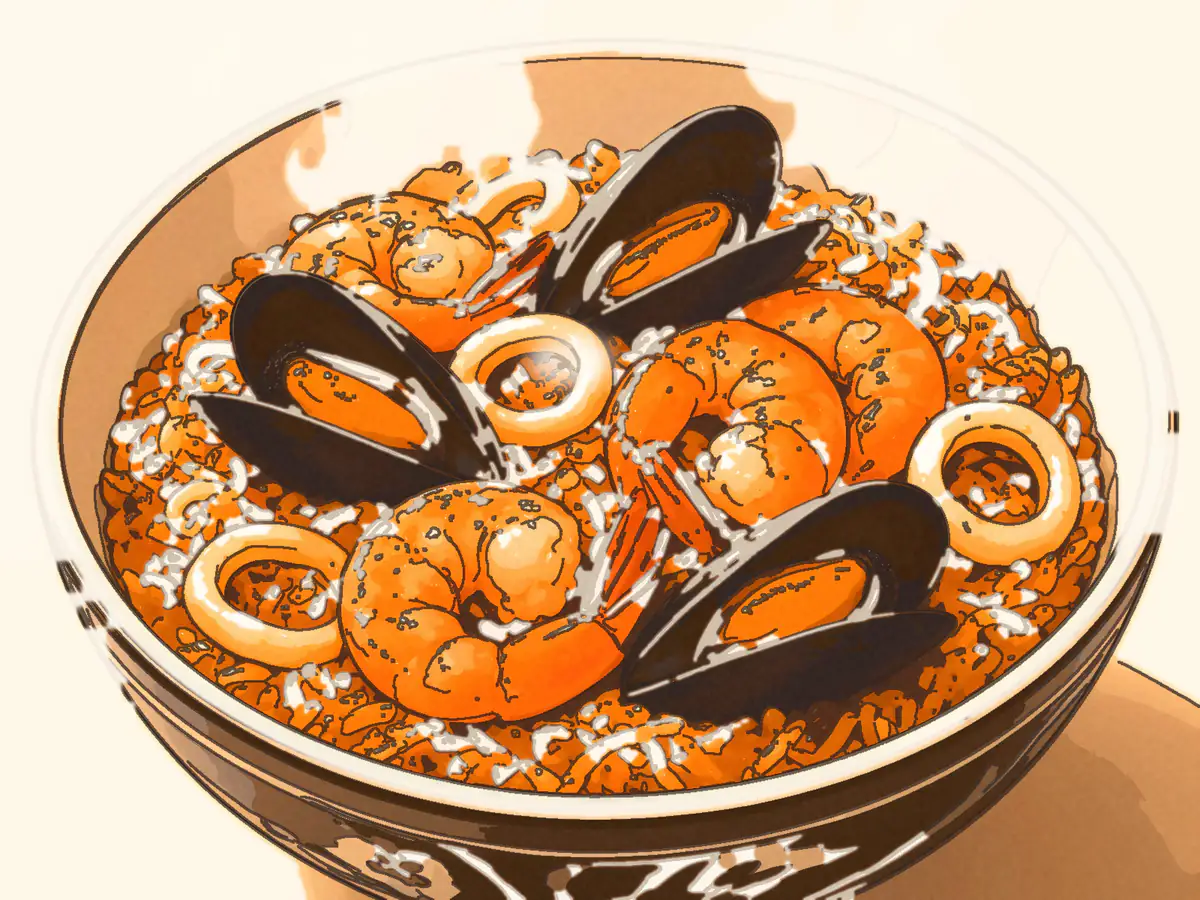
In the series, Sanji serves a plate of seafood rice to Gin, a starving pirate who has been thrown out of the floating restaurant Baratie (episode 21).
Sanji's Seafood Rice for Gin
A generous stir-fried rice with shrimp, squid and octopus, egg and peas: the dish nobody should ever refuse someone who shows up hungry.
approx. 530 kcal · midday plate
35 min (más arroz cocido del día anterior) · base recipe for 4 servings
Sanji's Seafood Rice for Gin
Ingredients
- 300 g long-grain rice (uncooked weight), cooked the day before and cold
- 200 g peeled shrimp or prawns
- 200 g cleaned squid, in rings
- 150 g cooked octopus, sliced
- 2 eggs (110 g)
- 100 g peas, 100 g onion and 100 g red bell pepper
- 2 garlic cloves (10 g)
- 30 ml olive oil
- 30 ml soy sauce and 2 g salt
- 20 g scallion (spring onion) and half a lemon
Get ready
- Wash your hands with warm water and soap and dry them well. Wash them again every time you touch raw shrimp, squid or egg.
- If the seafood is frozen, thaw it the night before in the fridge, in a colander set over a plate. Never thaw it at room temperature.
- Take the day-old cooked rice out of the fridge and put it in a large bowl: it should be cold, dry and separate, not damp or sticky.
- Measure 30 ml of soy sauce and 2 g of salt into a small bowl. Measure the oil into three 10 ml spoons or small bowls, one for each round.
- Put the raw seafood (shrimp and squid) on one plate and the cooked octopus on another. Use one cutting board just for the raw seafood and another clean one for the vegetables.
- Have your wok or the largest frying pan you own ready, along with a wide spatula and a large plate for the stir-fried seafood.
- Everything should be cut and measured before you turn on the heat: the stir-fry takes just a few minutes and there's no time to chop anything once the wok is hot.
Tools
- Very large wok or frying pan
- Wide spatula or wooden spoon
- Two cutting boards (raw seafood and vegetables)
- Chef's knife and paring knife
- Scissors or knife for the squid
- Fork and bowl for beating the eggs
- Large bowl for the rice
- Large plate for holding the seafood
- Small bowls for measuring the oil and sauce
- Paper towels
- Measuring spoons (5 ml and 15 ml)
- Colander (for the peas)
- Clock or timer
Steps
- Pat the shrimp and squid rings dry with paper towels, one by one. The drier they are, the better they brown; if they're wet, they release water and boil instead of stir-frying.Wet seafood cools the wok and makes the oil spit. Two minutes of drying saves you a lackluster stir-fry.
- If the shrimp are large, cut them into pieces of about 2 cm (lengthwise and then in half); if they're small, leave them whole. Hold each one with your fingertips curled in a claw grip and cut with the chef's knife.Hold the knife by pinching the blade with your thumb and index finger just in front of the handle: that gives you more control.
- Wash your hands and switch boards. Peel the onion, cut it in half through the root and lay the flat side on the board. Make thin horizontal cuts toward the root without cutting through it, then vertical cuts, and finally cut crosswise: you'll get dice of about 5 mm.With your hand in a claw grip and your knuckles guiding the blade, there's no finger in the way.
- Cut the red bell pepper: remove the stem and seeds, open it into wide strips, flatten each strip skin side down and cut it into 8 mm strips and then 8 mm dice.Skin side down, the blade slips less and you cut more safely.
- Peel the 2 garlic cloves, crush them with the flat of the knife and mince them very finely, into 1–2 mm bits. Keep the garlic separate, not on top of the onion, because it goes in later.
- Cut the cooked octopus, which already comes sliced, into 1 cm dice. Put them on a separate plate, away from the raw seafood.
- Slice the scallion into thin 2 mm rings (the green and white parts, as far as it looks tender). Cut the half lemon into 2 wedges. Set them aside on a small plate for the end.
- Crack the 2 eggs into a bowl, one at a time, and beat them with a fork until you can't tell yolks from whites, without making foam. Remove any bits of shell and wash your hands with soap.If you crack each egg into a cup first, you can scoop out any shell with a clean half shell.
- With clean, slightly damp hands, break up the clumps in the cold rice until every grain is separate. Smell the rice: it should smell neutral, like cooked rice; if it smells sour, throw it away.Dry, cold day-old rice is the key to the stir-fry: freshly made rice gets squashed and sticky. It must have been cooled quickly and kept in the fridge for no more than 24 hours.
- Heat the wok over high heat for 1 minute, until you feel intense heat when you hold your hand about 10 cm above it. Add 10 ml of oil and swirl to coat the bottom: it's ready when it looks glossy and fluid, with a fine ripple.If the oil smokes heavily, lower the heat for a moment: it's already hotter than it needs to be.
- Add the shrimp and squid in a single layer and stir-fry over high heat for 2 minutes, moving them every 20 seconds. The shrimp are done when they're pink and opaque and curl into a C; the squid, when it's white and opaque, with nothing translucent. Transfer them to the plate.Don't leave them more than 2 minutes: past that point the squid turns rubbery. If they're getting overdone, it's better to take them out and finish them with the rice.
- Wash your hands and clean the spatula if it touched the raw seafood. Add 10 ml of oil to the wok over medium-high heat and add the onion and bell pepper. Sauté for 3 minutes, stirring, until the onion is translucent and the pepper a little soft but still with some bite.
- Add the minced garlic and sauté for 1 more minute, stirring constantly. It should smell strong but not darken: if it turns brown, it turns bitter.The garlic goes in at the end of the sauté because, minced this finely, it burns in seconds.
- Push the vegetables to one side of the wok. Pour the beaten eggs into the gap and scramble for 1 minute until fully set, with no runny parts. Break them up with the spatula into 1 cm pieces and mix them with the vegetables.The egg must set completely, not just on the outside: nothing should look shiny or runny.
- Turn the heat to high, add the last 10 ml of oil and add the cold rice. Spread it around the wok with the spatula, pressing it against the metal and lifting it, until you hear it sizzle. Stir-fry for 4 minutes nonstop: the grains should jump around separately, steam and feel hot right to the center.To check that it's hot inside, taste a grain: it should be a little too hot, not lukewarm.
- Add the peas and the diced octopus. If the peas are frozen, there's no need to thaw them; if they're from a jar, drain them first. Stir-fry for 1 minute.
- Add the reserved seafood with any juices it released on the plate and mix for 30 seconds so everything heats through again.
- Pour the soy sauce in a circle around the edge of the wok, so it sizzles and caramelizes as it hits the hot metal, and sprinkle over the 2 g of salt. Mix for 2 minutes until the rice is an even color and everything is steaming.If you pour it straight onto the rice, it gets soggy and doesn't toast.
- Taste a little and adjust if needed. Check that the shrimp are opaque, the squid white and the rice steaming all over. Turn off the heat.If the rice isn't steaming inside, give it 1 more minute: reheated seafood must be piping hot.
- Divide the rice among bowls or onto a large plate with the spatula, forming a mound.
- Scatter the raw scallion rings over the top. Serve right away, with the lemon wedge on the side, so everyone can squeeze it over before eating. If there are leftovers, cool the rice quickly and keep it covered in the fridge, and eat it within 24 hours.The lemon at the end brightens the seafood and cuts through the richness of the sauce.
Allergens
Contains: gluten, crustáceos, huevo, soja, moluscos.
A guide only; always check the label.
Sin verificar. La fuente describe el plato como una variante de risotto/arroz con calamar, pulpo y gambas; las proporciones y el resto de ingredientes son interpretación propia.
Aviso. Contiene crustáceos y moluscos.
Per serving, approx.
Energy · 530 kcal
Week menu
Put this dish on a lunch or a dinner. The combined list adds up the whole menu.
Notes
El agua de la wakame (versión vegana) figura ahora como línea de ingredientes.
En la ligera, el aceite (12 ml) se reparte en tres tandas de unos 4 ml; no lleva sal. La ficha no incluye agua ni sal añadida.
Arroz del día anterior: debe haberse enfriado rápido y guardado en la nevera (máximo 24 h) y recalentarse hasta que humee por dentro.
Marisco listo: gambas rosadas y opacas, en forma de C; calamar blanco y opaco, no más de 2 minutos para que no se ponga gomoso.
En la sin gluten, el método aprobado dice 'sigue los pasos de la original con tamari': aquí está desarrollado entero, con aviso de revisar etiquetas del pulpo y del marisco.
En la vegana, la seta de cardo sustituye al calamar y el aceite se reparte 15+10+10 ml.
Passport
Mark it when you cook it. If you upload a photo, the stamp is sealed.
In other kitchens
No notes yet. The first one can be yours.