
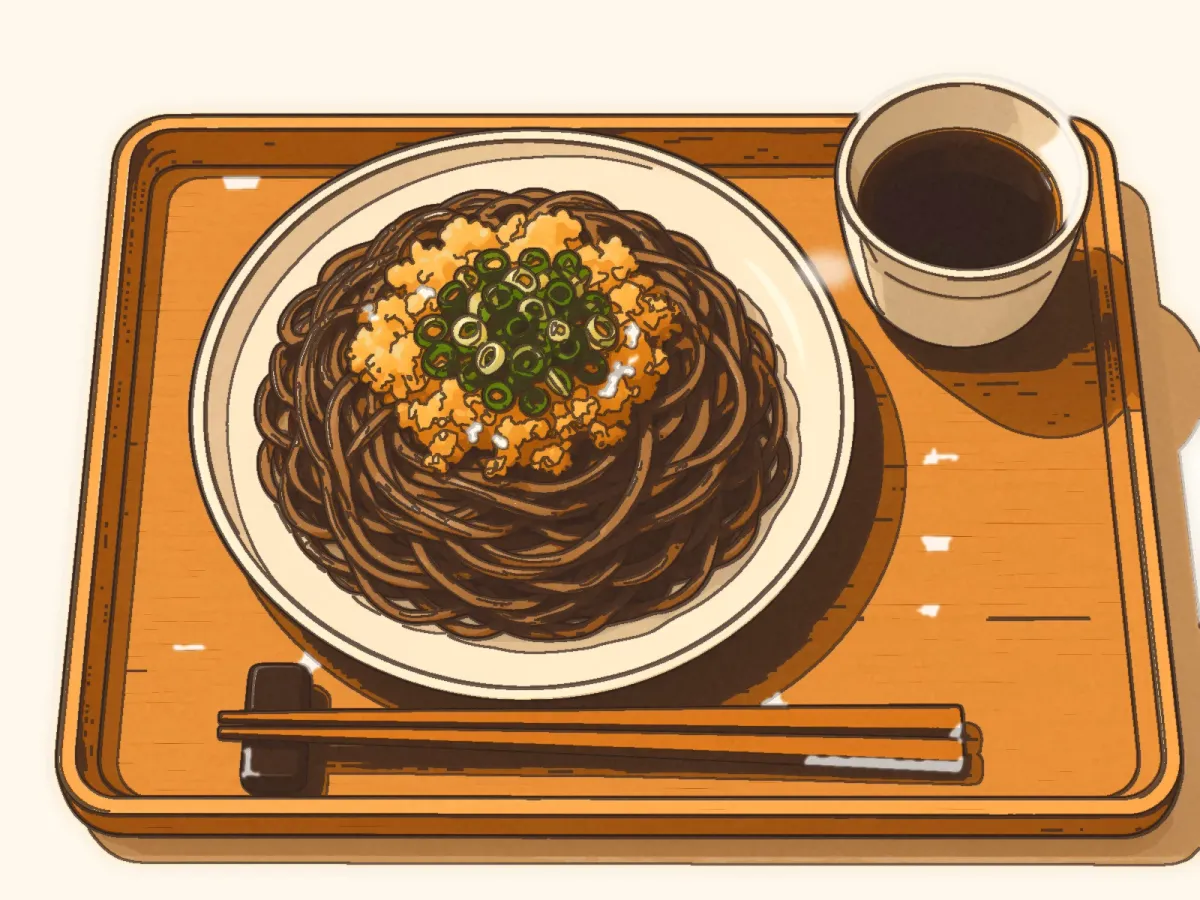
In the Wano arc, Sanji sets up a soba street stall right in the middle of the city (chapter 926, episodes 918–919).
Wano Street Stall Soba
Buckwheat noodles in hot dashi broth with mushrooms, egg and scallion: the steaming street-stall bowl you crave on a cold night. Soba are Japanese buckwheat noodles, and dashi is the light Japanese stock made from kombu seaweed and bonito flakes.
approx. 470 kcal · midday plate
30 min · base recipe for 2 servings
Wano Street Stall Soba
Ingredients
- 180 g dried soba noodles (buckwheat and wheat)
For the broth
- 800 ml water
- 10 g kombu seaweed
- 15 g dried bonito flakes (katsuobushi)
- 40 ml soy sauce
- 30 ml mirin
- 5 g sugar
To serve
- 80 g sliced shiitake mushrooms
- 2 eggs (110 g)
- 30 g scallion (spring onion), in rings
- Shichimi or pepper (optional)
- Water, as needed (at least 2 l, for cooking the soba)
Get ready
- Wash your hands with warm water and soap and dry them well. Wash them again after touching the eggs in their shells.
- Measure 800 ml of water in a pitcher and weigh out 10 g of kombu and 15 g of bonito flakes in two separate bowls.
- Measure 40 ml of soy sauce, 30 ml of mirin and 5 g of sugar into separate bowls. You'll add them together later.
- Put the 2 eggs in a bowl at room temperature. Have two small cups ready to crack each egg separately before poaching.
- Have a large pot for cooking the noodles (at least 2 liters of water), a large colander and a deep bowl for each person.
- Wipe the kombu with a slightly damp cloth, without washing it: the white powder on the surface is flavor.
- Keep the shiitake and scallions on separate boards if you can. Everything will be cut before you heat the broth.
Tools
- Medium pot for the dashi
- Large pot for cooking the noodles
- Fine-mesh strainer (for the dashi) and large colander (for the soba)
- Paper towel or clean cheesecloth (optional, for a clearer broth)
- Cutting board and chef's knife
- Ladle and slotted spoon
- Two small cups for cracking the eggs
- Measuring cup and measuring spoons (5 ml and 15 ml)
- Kitchen scale
- Slightly damp cloth
- Two deep bowls for serving
- Chopsticks (optional) and spoon
- Clock or timer
Steps
- Wipe the kombu with the damp cloth to remove the dust, without rubbing hard. Make 2 or 3 cuts of 2–3 cm along the edges with scissors or a knife so it releases its flavor better.Don't rinse it under the tap: the white coating is natural glutamate, the source of the flavor.
- Put the kombu in the pot with the 800 ml of cold water and leave it to soak for 20 minutes at room temperature. Meanwhile, prepare the mushrooms and scallion.The longer the cold soak, the more flavor it releases; even 20 minutes makes an aromatic broth.
- Cut off the tough shiitake stems with a knife and discard them. Slice the caps 3–4 mm thick, keeping your fingers in a claw grip.Evenly thick slices cook at the same time.
- Slice the scallion into 2 mm rings, using mostly the green part. Set them aside in a small bowl.
- Put the dashi pot over medium-low heat. Heat until you see tiny bubbles clinging to the bottom and the edges of the kombu, about 8–10 minutes, without letting it boil. Remove the kombu just before it boils, with tongs or a spoon.If the water boils with the kombu in it, the broth turns bitter and a little slimy.
- Raise to medium heat until the broth bubbles gently, add the 15 g of bonito flakes and turn off the heat right away. Let them steep for 3 minutes without stirring, until they sink.Don't boil the bonito: it turns bitter and smells strongly of fish.
- Strain the dashi through a fine-mesh strainer (lined with paper towel or cheesecloth for a clearer broth) into a clean container, without pressing the flakes. Discard the kombu and flakes, or save the kombu for another recipe.Pressing the flakes clouds the broth and gives it a harsh taste.
- Return the dashi to the clean pot. Add the 40 ml of soy sauce, 30 ml of mirin and 5 g of sugar, and stir until the sugar dissolves.Taste a teaspoon: it should taste of the sea, lightly sweet and salty.
- Add the shiitake slices and heat over medium-low heat for 5 minutes, with small gentle bubbles, until the mushrooms are tender and sink.
- Put the large pot with plenty of water (at least 2 liters) for the noodles over high heat until it boils hard. Don't add salt.Lots of water keeps the noodles from sticking.
- While the water heats, crack each egg into a separate small cup. That way you can check there are no bits of shell and the yolk is whole. Throw away cracked eggs before breaking them open.Wash your hands with soap after touching the eggs.
- Lower the broth with the mushrooms to a barely visible simmer, with a few small bubbles at the edge. Gently slide in one egg and then the other, and poach them for 3 minutes, until the white is set and the yolk is hot but creamy. Lift them out with the slotted spoon onto a plate.If it boils hard, the white breaks up. Anyone who needs a firmer yolk can leave them for 5 minutes.
- Cook the soba in the boiling water according to the package (usually 4–5 minutes), stirring gently at first with chopsticks. Taste a noodle: it should be tender, with no dry white center.Always taste noodles a minute before the package time.
- Drain the soba in the large colander and rinse it under cold running water, rubbing it with your hands until the water runs clear and the noodles aren't slimy.The cold water stops the cooking and removes the starch: without this step the broth turns cloudy.
- Reheat the soba: dip the colander into the boiling cooking water for 10 seconds and drain well. That way the noodles arrive hot in the bowl.Without this step, the broth cools down when it hits the cold noodles.
- Divide the soba between two deep bowls, coiling it with tongs or chopsticks so it looks neat.
- Pour the hot broth with the mushrooms over each bowl, until almost all the noodles are covered. The broth should be steaming and very hot.
- Gently place a poached egg in each bowl and scatter the scallion rings over the top.
- Serve right away. If you like heat, sprinkle a little shichimi (Japanese seven-spice chili blend) or ground pepper on top at the end. Eat the noodles hot, slurping noisily if you feel like it: it cools them down and brings out the flavor.Eat the soba as soon as it's served: after 5 minutes it soaks up the broth and goes soft.
Allergens
Contains: gluten, huevo, pescado, soja.
May contain: sulfitos.
A guide only; always check the label.
Sin verificar. Las guarniciones concretas del soba de Sanji no están documentadas en la fuente revisada; esta es una interpretación propia de kake soba (soba en caldo caliente).
Deja parte del caldo. En este plato, alrededor del 85 % de la sal está en el caldo (salsa de soja, miso, sal o caldo). Si te lo tomas todo, la ración aporta unos 3,8 g de sal (aprox.); si dejas en el cuenco un tercio del caldo, baja a unos 2,7 g (aprox.). Como referencia, la OMS recomienda no pasar de 5 g de sal al día en adultos. Disfruta de todo lo sólido y bebe el caldo a sorbitos, sin prisa.
Per serving, approx.
Energy · 470 kcal
Week menu
Put this dish on a lunch or a dinner. The combined list adds up the whole menu.
Notes
El agua para cocer los fideos (y para escaldar las espinacas) figura ahora como línea de ingredientes («al menos 2 l»); el agua de 800 ml de la ficha es solo la del caldo. No se añade sal a esa agua.
Huevos escalfados 3 minutos: yema cremosa. Quien esté embarazada, tenga las defensas bajas o sirva el plato a niños pequeños puede dejarlos 5 minutos; no se ha cambiado el tiempo aprobado.
En la ligera, la ficha no lleva azúcar (el método aprobado dice 'la mitad de mirin, sin azúcar'); el caldo se sazona solo con soja reducida en sal y mirin.
En la sin gluten, vigilar la soba 100 % sarraceno (frágil), usar tamari y mirin con sello y una olla limpia sin restos de trigo; el dashi en polvo y el mentsuyu suelen llevar trigo.
En la vegana, el kombu y las shiitake secas viajan en la misma línea de la ficha; la soba mixta lleva trigo, así que no es sin gluten. El tofu se dora con solo 5 ml de aceite: usar sartén antiadherente.
El pie duro de las shiitake no figura en la ficha: se descarta al laminar.
Passport
Mark it when you cook it. If you upload a photo, the stamp is sealed.
In other kitchens
No notes yet. The first one can be yours.