
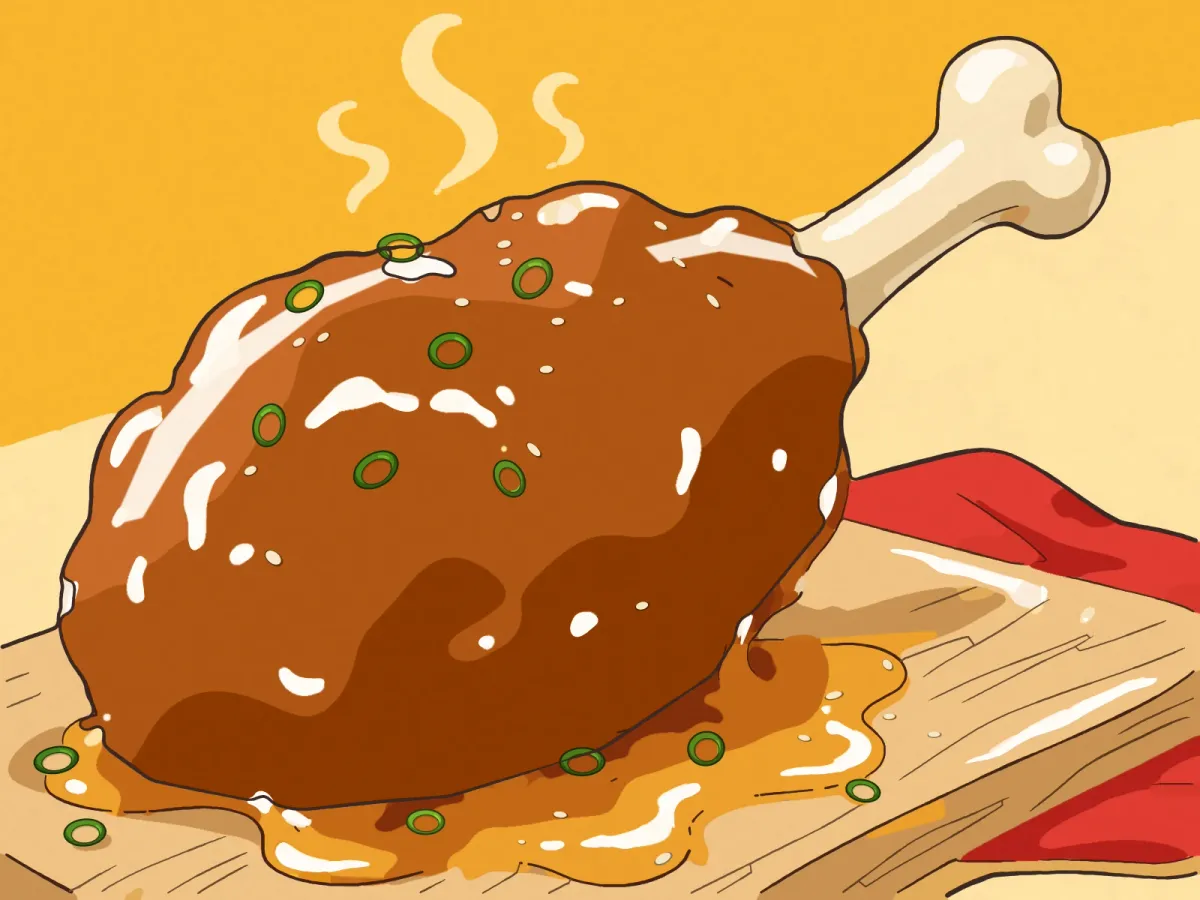
In the series, meat is Luffy's favorite food, and big pieces of meat on the bone show up all the time at his crew's feasts.
Luffy's Meat on the Bone
Whole turkey legs, glazed and glossy, with the bone to hold on to: party food to share with your crew.
approx. 605 kcal · midday plate
2 h 15 min (20 min activos) · base recipe for 4 servings
Luffy's Meat on the Bone
Ingredients
- 2 whole skin-on turkey legs (about 1.4 kg; ≈1 kg edible meat)
- 4 g salt and black pepper to taste
For the glaze
- 40 g honey
- 45 ml soy sauce
- 30 g tomato paste (tomato purée)
- 15 ml rice or apple cider vinegar
- 2 garlic cloves, grated (10 g)
- 5 g sweet paprika
- 15 ml olive oil
Side
- 600 g potatoes, in 0.5 cm slices
- 1 onion (150 g), thinly sliced
- 15 ml olive oil
Get ready
- Wash your hands with warm water and soap and dry them well. Wash them again every time you touch the raw turkey.
- Take the legs out of the fridge 30 minutes before turning on the oven, so they aren't fridge-cold when they go in.
- Gather a large baking sheet, aluminum foil or parchment paper, a pastry brush and a probe thermometer if you have one.
- Measure the glaze into separate bowls: 40 g honey, 45 ml soy sauce, 30 g tomato paste, 15 ml vinegar and 5 g sweet paprika. Keep the 15 ml of glaze oil and the 15 ml of side oil in two spoons or bowls, so you don't mix them up.
- Keep the 4 g of salt and pepper handy (you'll use part for the turkey and part for the potatoes), along with the 2 garlic cloves.
- Set aside one board just for the raw turkey and another clean one for the potato and onion.
Tools
- Two cutting boards (one for the raw turkey and one for vegetables)
- Chef's knife and a paring knife or peeler
- Fine grater or garlic press
- Paper towels
- Large baking sheet
- Aluminum foil or parchment paper to wrap the bone tip
- Small saucepan for the glaze
- Wooden spoon or whisk
- Pastry brush
- Kitchen tongs
- Bowls for measuring the glaze
- Kitchen scale and measuring spoons
- Probe thermometer (recommended)
- Clock or timer
- Oven mitts
Steps
- Preheat the oven to 170 °C (340 °F), conventional (top and bottom heat), with the rack in the lower third. It's ready when the indicator light goes off or when, opening it for a second, you feel a dry, steady heat.If your oven takes more than 15 minutes, turn it on when you start cutting the vegetables.
- Pat the turkey legs dry with paper towels on all sides, including in the folds of the skin and next to the bone. The skin should look matte, not shiny with moisture.Dry skin crisps; wet skin steams and stays soft.
- Spread about 3 g of the salt and pepper over the legs: sprinkle it over the skin, underneath (lift the edge with your fingers) and next to the bone. Save the rest of the salt for the potatoes. Rub it in briefly so it sticks.Don't pierce the meat: the juices would escape. Wash your hands when you're done.
- Peel the potatoes. Cut them into 0.5 cm slices: hold the knife in your dominant hand and, with the other, make a “claw” (fingertips tucked behind your knuckles) to guide the blade. The slices should be the same thickness so they roast at the same time.If a potato is very large, halve it lengthwise first and then slice it: the slices fit better on the tray.
- Peel the onion, cut it in half from root to tip and slice each half into 3 to 4 mm strips, following the grain. Keep the claw grip and move slowly toward your fingers.If your eyes water, wet the knife or work next to a trickle of cold water.
- Spread the potato slices and onion strips on the tray. Drizzle with the 15 ml of side oil (not the glaze oil) and the rest of the salt and pepper. Toss with your hands or a spoon until everything is glossy, in a single layer, without piling up.If the tray is very full, use two: the potatoes should roast, not steam.
- Place the legs on top of the vegetables, skin side up, with the bone toward one end of the tray so you can turn them later with tongs.That way the fat from the skin drips onto the potatoes and flavors them.
- Put the tray in the oven at 170 °C (340 °F) and roast for 35–40 minutes. The potatoes will start to sizzle softly and the turkey skin will turn pale and tighten.Don't keep opening the oven: you lose heat.
- Take the tray out with oven mitts. With tongs, turn each leg (skin side down for a moment and then back up, or on its side if that's easier) so it browns all over. Return it to the oven for another 35–40 minutes, for a total of 1 hour 15 minutes at 170 °C (340 °F). The skin should start to crisp and the potatoes to brown at the edges.If the edges of the tray get too dark, move the tray down a little or cover just those ends with a piece of foil.
- While the turkey is still in the oven, peel the 2 garlic cloves and grate them on a fine grater (or press them) into a paste. Set aside.Grated garlic melts into the glaze; if you chop it into large pieces, you'll get raw specks.
- In a small saucepan, off the heat, mix the honey, soy sauce, tomato paste, vinegar, grated garlic, sweet paprika and the 15 ml of glaze oil. Stir until there are no lumps of tomato paste.If the honey is very thick, warm it for 10 seconds between your hands or next to the already warm saucepan.
- Put the saucepan over medium heat and cook the glaze for 2 minutes, stirring constantly. It's ready when it thickens slightly, makes lazy bubbles at the edge and smells of toasted soy sauce and tomato, not burnt.If it starts to spit or suddenly darkens, take it off the heat and keep stirring in the residual heat.
- Take out the tray. With the brush, paint the legs with a generous layer of glaze, including the sides and next to the bone. Save the rest of the glaze for the next layers.Don't drench the potatoes: the sugar would burn on the bottom. A little dripping is fine.
- Turn the oven up to 200 °C (400 °F) and, once it reaches temperature (the indicator light goes off again), put the tray in.That 200 °C (400 °F) caramelizes the glaze; don't do this step earlier or the sugar would burn during the first roast.
- Roast for 10 minutes at 200 °C (400 °F). The glaze should start to bubble and darken at the edges, without turning black.
- Take out the tray and brush another layer of glaze over the legs.Each layer adds shine; there's no need to flood them.
- Return the tray to the oven for another 10 minutes at 200 °C (400 °F).
- Brush on a final layer with the remaining glaze and roast for 10 more minutes (30 minutes in total at 200 °C / 400 °F). You're looking for: dark, glossy skin, not charred; a thermometer inserted next to the bone reads at least 75 °C; without a thermometer, the juices run clear, not pink, and the meat next to the bone no longer looks raw.If any area gets too dark before reaching 75 °C, cover just that spot with a little foil and keep going until it reaches the safe temperature.
- Let the legs rest for 5 minutes out of the oven. Cut two strips of parchment paper or foil and wrap just the tip of each bone, like a handle, so you can hold them without burning yourself.Resting lets the juices redistribute: if you cut right away, they run out onto the plate.
- Cut each leg in half (or serve one whole leg for two people) with a sharp knife, working along the bone. Serve half a leg per person with the roasted potatoes and onion from the tray, and any glossy juices left behind.Use the clean board, not the one for the raw turkey.
Allergens
Contains: gluten, soja.
May contain: sulfitos.
A guide only; always check the label.
Per serving, approx.
Energy · 605 kcal
Week menu
Put this dish on a lunch or a dinner. The combined list adds up the whole menu.
Notes
El agua para hervir y para el vapor del seitán (versión vegana) figura ahora como línea de ingredientes: «Agua, la necesaria (para hervir y para el vapor del seitán)».
En la original y en la sin gluten hay dos líneas de «15 ml de aceite de oliva» (glaseado y guarnición): se usan por separado, con el mismo nombre de ficha.
En la vegana hay dos líneas de «30 ml de salsa de soja» (masa y glaseado); se asignan a esos pasos. El pimentón ahumado viaja en la línea combinada con el ajo.
Temperatura segura del pavo: 75 °C junto al hueso, o jugos claros y carne que ya no se ve cruda junto al hueso.
Passport
Mark it when you cook it. If you upload a photo, the stamp is sealed.
In other kitchens
No notes yet. The first one can be yours.