
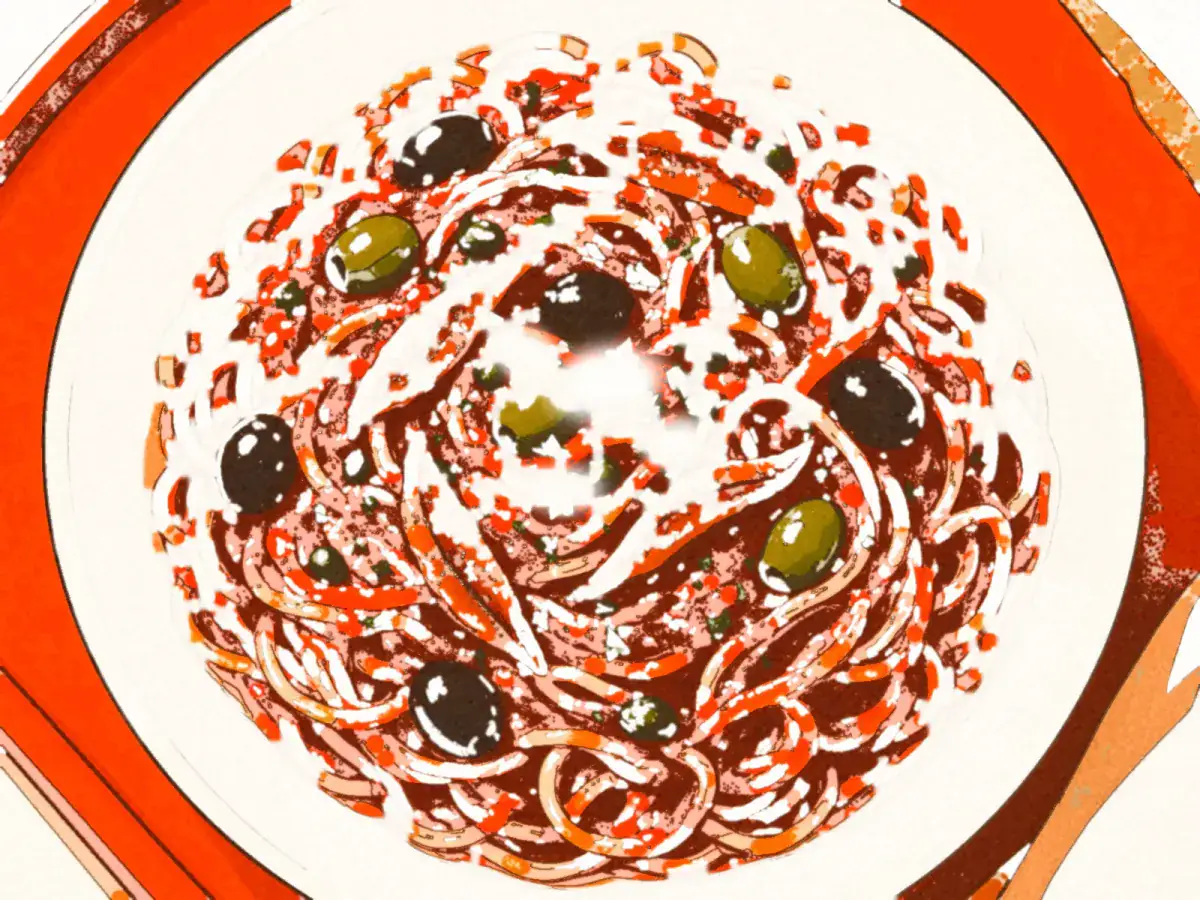
In a small-town trattoria, the chef serves Italian pasta with an almost magical devotion to his customers' well-being.
Un plato de pasta de trattoria; sin spoilers de poderes ni peleas.
Tonio's Spaghetti Puttanesca
Al dente pasta with tomato, anchovy, olives and capers: bold and comforting.
approx. 560 kcal · midday plate
30 min · base recipe for 2 servings
Tonio's Spaghetti Puttanesca
Ingredients
- 200 g spaghetti
- 2 l water for cooking the pasta (approx.)
- 400 g crushed tomatoes
- 30 g anchovies in oil
- 40 g black olives
- 15 g capers
- 20 ml olive oil
- 10 g garlic
- 5 g dried chili or paprika
- 2 g salt
Get ready
- Wash your hands.
- Have a large pot with about 2 liters of water and the colander ready.
- Peel the garlic (10 g) and drain the anchovies and capers in a small sieve.
- Weigh the spaghetti (200 g), the crushed tomatoes (400 g), the olives (40 g), the oil (20 ml), the paprika and the salt (2 g).
- Keep a cup or small pan ready to save some of the pasta cooking water.
Tools
- Large pot and colander
- Wide, deep frying pan
- Cutting board and chef's knife
- Wooden spoon
- Kitchen tongs
- Cup for the pasta water
- Small sieve
- Kitchen scale and measuring spoons
- Timer
Steps
- Put the pot on high heat with about 2 liters of water and the 2 g of salt, covered, until it comes to a rolling boil.The anchovies, olives and capers already make the sauce very salty: that's why the salt in the water is minimal.
- Slice the garlic 1 to 2 mm thick. Tuck your fingertips into a claw and glide the knife with thin, even cuts.Thinly sliced garlic browns in no time: cut everything before you turn on the pan.
- Slice the black olives 3 mm thick. If they have pits, remove them first by pressing the olives with the flat of the blade.
- Drain the capers and, if they're in brine, rinse them under the tap for 10 seconds. Chop them into 3 to 4 mm pieces.
- Drain the anchovies from the oil in the can and chop them very finely, into 2 to 3 mm pieces, until almost a paste.The finer they are, the faster they melt into the sauce.
- Put the wide frying pan on medium-low heat with the olive oil (20 ml). Add the sliced garlic and cook for 30 to 40 seconds, until fragrant and a very pale gold, without darkening.If the garlic turns dark brown, it goes bitter: take the pan off the heat and start again with another clove.
- Add the chopped anchovies and stir with the wooden spoon for 1 to 2 minutes over low heat, until they break down into a paste in the oil.
- Take the pan off the heat for 10 seconds, add the paprika (5 g) and stir it in; put the pan back on the heat. If you like it spicy, use chili flakes.Paprika burns in seconds and turns bitter: never add it to very hot oil.
- Pour in the crushed tomatoes (400 g) and stir. Turn up to medium heat until it bubbles, then lower to medium-low.
- Simmer the sauce for 8 minutes over medium-low heat, stirring now and then, until it thickens and leaves a trail when you drag the spoon through.If it spatters a lot, half-cover it.
- Add the olives and capers, mix and cook for 4 to 5 more minutes over medium-low heat, until the sauce smells bold and the oil glistens at the edges.Taste before salting: it doesn't need more salt.
- When the water is at a rolling boil, add the spaghetti, push it under with the spoon as it softens and stir for the first minute so it doesn't stick.
- Cook the pasta over high heat for 1 minute less than the package time (about 8 to 9), until it has a very thin white thread in the center when you bite it (al dente).Set the timer and don't cover the pot: that way it won't boil over.
- Before draining, save a cup (about 100 ml) of the cooking water.The starchy water brings the sauce and pasta together; without it the dish turns dry.
- Drain the pasta in the colander without rinsing it and move it straight to the frying pan with the sauce.
- Toss for 1 minute over medium heat with the tongs, adding a splash of the reserved water if needed, until the sauce coats the spaghetti and looks glossy, not watery.
- Serve right away in pasta bowls, spooning the sauce from the pan over the top. Serve with an unsalted salad.The pasta keeps soaking up sauce: don't leave it waiting.
Allergens
Contains: gluten, pescado.
May contain: huevo.
A guide only; always check the label.
Sal alta. Sal alta por anchoas, aceitunas y alcaparras (es el perfil del plato); sirve con ensalada sin sal.
Per serving, approx.
Energy · 560 kcal
Week menu
Put this dish on a lunch or a dinner. The combined list adds up the whole menu.
Notes
El agua de cocción de la pasta (unos 2 l; 1,5 l en la ligera) figura ahora como línea de ingredientes, y la taza reservada sale de ella.
Los 2 g de sal de las fichas original, sin gluten y vegana se echan en el agua de la pasta (cantidad mínima, porque la salsa ya es salada). La versión ligera no lleva sal en la ficha y no se añade.
Original: el pimentón (5 g, «guindilla o pimentón») se añade fuera del fuego para que no se queme.
Versión ligera: 5 ml de aceite para la salsa y 5 ml para el calabacín. No lleva guindilla ni sal.
Versión sin gluten: la pasta de arroz o maíz se cuece 1 minuto menos y no se aclara; comprobar el sello de las anchoas y aceitunas es una recomendación, no cambia cantidades.
Versión vegana: sin anchoas; el nori y la soja dan el punto salino. El aviso de sal alta de la ficha se mantiene. La pasta seca no es sin gluten.
Passport
Mark it when you cook it. If you upload a photo, the stamp is sealed.
In other kitchens
No notes yet. The first one can be yours.