
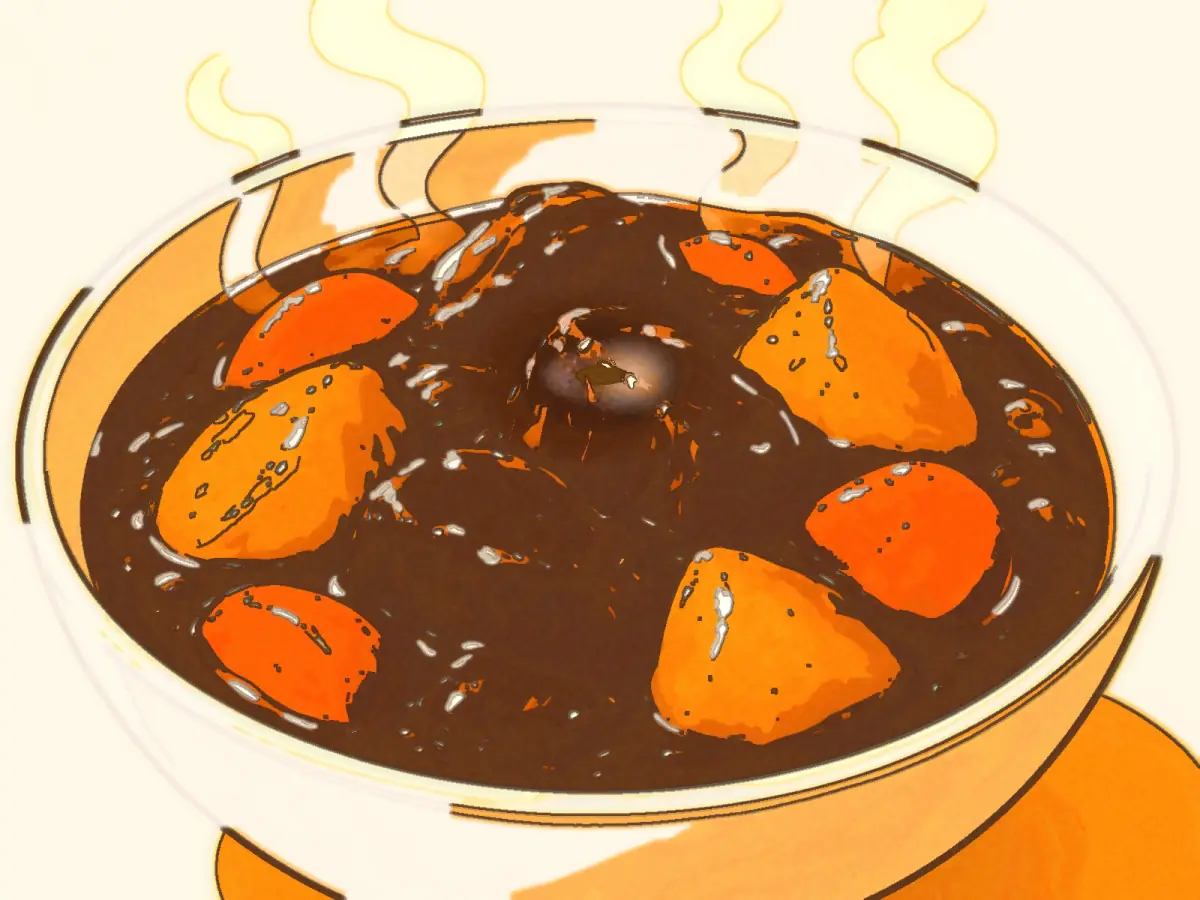
In the series, Yor learns to make her mother's stew, a southern-style stew, with help from her colleague Camilla, who finishes it with sour cream; it's served with a fried egg on top (episode 16).
Yor's Mother's Stew
A beef stew with paprika and potato, topped with a fried egg and a spoonful of sour cream: the family recipe that tastes like home.
approx. 570 kcal · midday plate
2 h 15 min (30 min activos) · base recipe for 4 servings
Yor's Mother's Stew
Ingredients
- 600 g stewing beef (chuck or shin), diced
- 20 ml olive oil
- 250 g onion and 150 g red bell pepper
- 10 g garlic
- 10 g sweet paprika and 2 g cumin or caraway
- 30 g tomato paste (tomato purée)
- 600 ml homemade beef or chicken stock
- 400 g potato and 150 g carrot
- 4 g salt and pepper
To serve
- 4 eggs (220 g) and 10 ml oil
- 80 g sour cream
- Hot water, a little, only if the stock doesn't cover the meat
Get ready
- Wash your hands with soap and water; wash them again and clean the board and knife after touching the raw beef and the eggs.
- Take the beef out of the fridge 20 minutes before browning it. Measure 600 ml of stock in a pitcher.
- Weigh 250 g of onion, 150 g of pepper, 10 g of garlic, 400 g of potato and 150 g of carrot. Have 2 bowls ready for the chopped vegetables.
- Measure 10 g of paprika and 2 g of cumin into a small bowl, and 30 g of tomato paste into another. Weigh 4 g of salt.
- Set aside 20 ml of oil for the stew and 10 ml for frying the eggs. Have a 4-liter pot with a lid handy.
Tools
- 4-liter pot with a lid
- Wooden spoon
- Chopping board and chef's knife
- Peeler
- Bowls for the vegetables and a plate for the meat
- Measuring cup and kitchen scale
- 24 cm non-stick frying pan
- Spatula and a cup for cracking the eggs
- Paper towels
- 4 deep plates
Steps
- Cut the 600 g of stewing beef into 3 cm cubes, trimming off tough sinew and excess fat with the tip of the knife. Hold the meat with your hand in a claw and make firm, straight cuts.3 cm cubes hold up to an hour and a quarter of cooking without falling apart or drying out.
- Pat the cubes dry with paper towels, one by one, and lay them on a plate without piling them up.Dry meat browns; wet meat boils and turns gray.
- Peel the onions and cut them in half from top to bottom. Lay the flat side on the board and make cuts parallel to the board without reaching the root, then vertical cuts.
- Turn the onion and cut it into 1 cm dice. Set aside in a bowl.An even size softens evenly and melts a little into the stew.
- Wash the 150 g of pepper, cut it into quarters, remove the stalk and seeds and cut it into 1 cm strips, skin side down. Then cut it into 1 cm dice and mix it with the onion.With the skin side down, the knife grips and doesn't slip.
- Peel the 10 g of garlic (2 cloves), crush them with the flat of the knife and chop them very finely, into 2 mm pieces.Finely chopped garlic melts into the stew; if you slice it, it burns.
- Peel the 400 g of potato and cut it into irregular chunks of about 3 cm. Set them aside in a bowl.A potato stew thickens better if the chunks are irregular: they release more starch.
- Peel the 150 g of carrot and cut it into 1 cm thick rounds, with your fingers in a claw.
- Heat the 20 ml of olive oil in a 4-liter pot over medium-high heat for 2 minutes, until the oil looks fluid and shiny, with a faint haze.If it smokes, turn down the heat: burnt oil makes the stew bitter.
- Brown the first half of the beef cubes, without crowding them: 2–3 minutes per side over medium-high heat, until each side has a dark brown crust and you hear a steady sizzle. If the meat sticks, don't force it: it releases by itself once browned.Browning in batches stops the meat releasing water and boiling instead of browning.
- Transfer the first batch to a plate and brown the second half the same way. Move it to the plate.
- Turn the heat down to medium-low. Add the onion and pepper to the pot and scrape the bottom with a wooden spoon to lift the browned bits. Soften for 10 minutes, stirring, until the onion is soft, translucent and lightly golden.The browned bits from the meat give the deep flavor.
- Add the chopped garlic and the 30 g of tomato paste. Stir for 2 minutes, until the tomato darkens to a brick red and smells sweet and concentrated.Frying the tomato takes away its raw acidity.
- Take the pot off the heat. Wait 30 seconds and sprinkle in the 10 g of sweet paprika and the 2 g of cumin. Stir for 10 seconds, until everything is tinted red.Paprika burns in seconds and turns bitter: that's why it goes in off the heat.
- Return the beef and its juices to the pot, mix it well with the vegetables and put it back over medium-low heat.
- Pour in the 600 ml of stock, scrape the bottom and bring to the boil over medium-high heat. When big bubbles appear, turn the heat down to the lowest setting.The stock should almost cover the meat; if it doesn't, add a little hot water.
- Cover the pot, leaving a gap, and cook over the lowest heat for an hour and a quarter. The liquid should barely move, with a bubble every few seconds. Stir every 25 minutes.A hard boil toughens the meat. Very gentle heat and more time is better.
- Check the meat: pierce a cube with a fork. It should be very tender and break apart with the edge of a spoon. If it resists, cook for 15 more minutes.This check makes sure the beef is tender and cooked through.
- Add the potato chunks, the carrot rounds and the 4 g of salt with a little ground pepper. Stir, cover and cook for 30 minutes over medium-low heat, until the potato and carrot are tender.Adding the salt at the end doesn't toughen the meat or leave the potato hard.
- Check that the potato is tender: a knife should go in without resistance. Crush 4 or 5 chunks against the bottom with the back of the spoon and stir for 5 minutes over medium heat, until the stew thickens and turns creamy.The potato starch thickens the stew without any need for flour.
- Taste the stew and adjust the salt and pepper if needed. Keep the pot covered over the lowest heat while you make the eggs.
- Heat the 10 ml of oil in a 24 cm non-stick frying pan over medium heat for 1 minute, until it spreads fluidly over the bottom. Crack the 4 eggs into a cup one at a time and check them.Cracking them into a cup stops bits of shell falling in and lets you see the yolk is whole.
- Slide the eggs into the pan over medium heat and fry them for 2–3 minutes, until the white is opaque and firm, with golden, frilly edges, and the yolk is glossy. Cover for the last 30 seconds so the top of the white sets.Pregnant women, people with weakened immune systems and young children should eat it with a set yolk: 1 more minute.
- Share the stew between 4 deep plates, with meat, potato and carrot in each.
- Place a fried egg on top of each plate and finish with a spoonful of sour cream (20 g). Serve straight away.The sour cream is added at the end, cold: don't cook it or it will split.
Allergens
Contains: huevo, lácteos.
May contain: gluten, apio.
A guide only; always check the label.
Sin verificar. La serie no detalla la receta completa: los ingredientes del estofado (ternera, pimentón, patata) son una interpretación propia, inspirada en guisos de Europa central, donde se ambienta la serie. Confirmado: estofado del sur, huevo frito y crema agria.
Per serving, approx.
Energy · 570 kcal
Week menu
Put this dish on a lunch or a dinner. The combined list adds up the whole menu.
Notes
El agua no figura como ingrediente: solo se usa para aclarar las alubias. Las cantidades no se tocan.
En la original y la sin gluten, el aceite de 10 ml se reserva para los huevos fritos. En la ligera, 2 ml sirven para untar la plancha, y se usa un chorrito del caldo medido (unos 50 ml de los 600) para pochar.
En la versión ligera no hay comino en la ficha; la ficha lista 3 g de sal y no hay pimienta. Con ternera magra, la cocción debe ser muy suave; se comprueba la ternera tierna con un tenedor.
En la vegana, la calabaza se asa en paquete de aluminio sin aceite (los 25 ml se reparten en 15 ml para los champiñones y 10 ml para el sofrito) y el tofu se marca en seco. La ficha menciona «discos»: se hacen de lonchas de 1,5 cm.
Seguridad: la ternera debe estar tierna y bien cocida; los huevos fritos se cuajan por completo para embarazadas, niños pequeños y personas con defensas bajas. La crema agria y el yogur se añaden al final, sin cocer.
Gluten: en la versión sin gluten, no se enharina la carne; caldo casero, pimentón con sello y crema agria sin espesantes con gluten. La ficha sin gluten no incluye comino.
Passport
Mark it when you cook it. If you upload a photo, the stamp is sealed.
In other kitchens
No notes yet. The first one can be yours.