
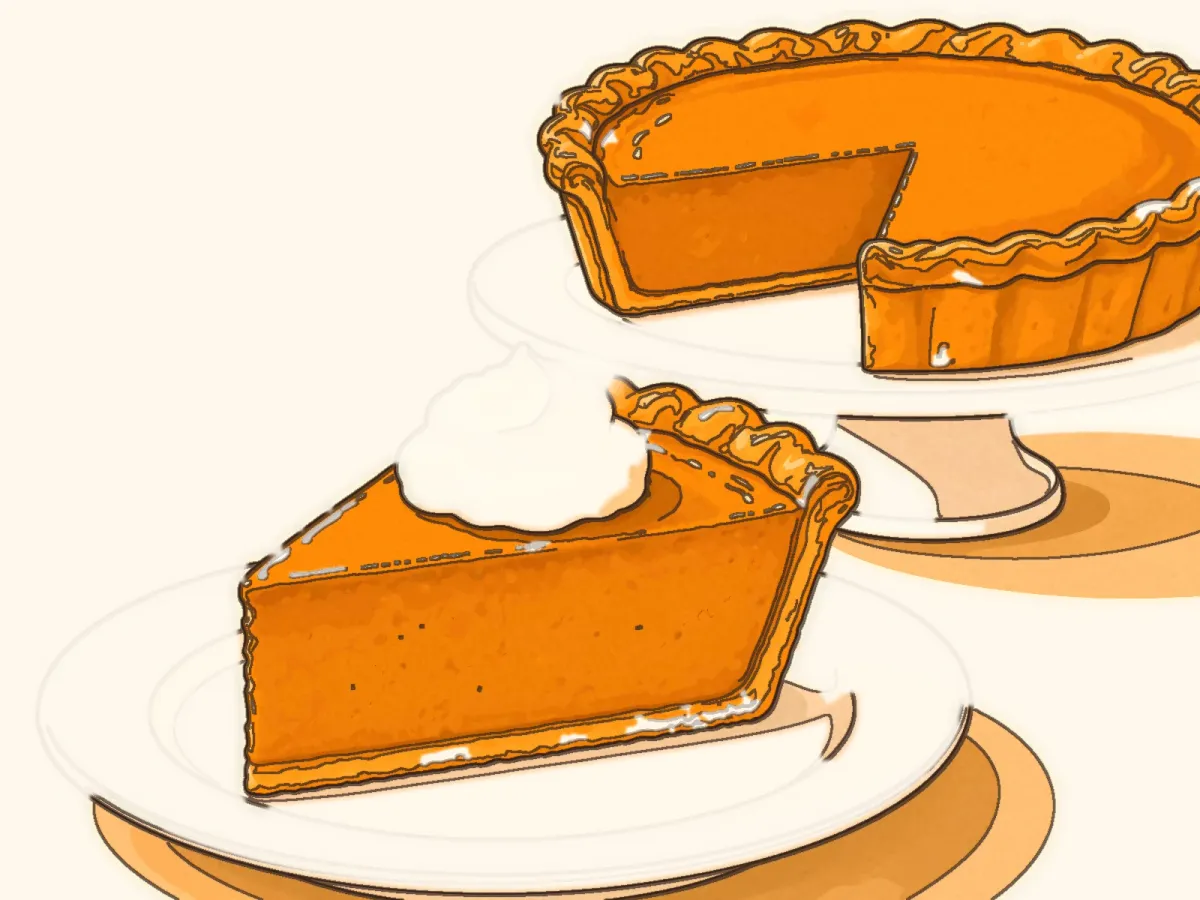
Inspired by Kiki's Delivery Service (Studio Ghibli). In the film, an elderly customer's electric oven breaks down and Kiki stays to help her: together they manage to bake, in the old wood-fired oven, the pie the lady wanted to give her granddaughter.
Pumpkin and Herring Pie
A baked pie with golden pastry, filled with roasted pumpkin, potato and smoked herring, with a fish drawn on the lid: perfect for taking to a party in the rain.
approx. 565 kcal · midday plate
1 h 30 min · base recipe for 6 servings
Pumpkin and Herring Pie
Ingredients
- 2 sheets of chilled ready-rolled shortcrust pastry (460 g)
- 500 g pumpkin, diced
- 200 g potato, diced
- 200 g smoked herring fillets
- 150 g onion, finely chopped
- 100 ml light cream (single cream, 18% fat)
- 2 eggs (one for the filling and one for glazing; 110 g)
- Dill, pepper and nutmeg
- 30 g black olives for decorating
- Water, 1 tbsp (15 ml), only if the onion sticks
Get ready
- Wash your hands after touching fish and eggshells.
- Take the 2 pastry sheets out of the fridge only 5 minutes before using them: they should be cold and easy to handle, not warm or soft. Don't cut them into pieces: they're used whole, one for the base and one for the lid.
- Preheat the oven to 200 °C (400 °F) to roast the pumpkin and potato.
- If the pumpkin and potato don't come diced, you'll cut them into 2 cm cubes in the first step. The herring is cut into strips later, not now.
- Measure 100 ml of cream. Set aside one egg for the filling and another for glazing.
- Chop a little fresh dill (or have dried dill ready) and grate a touch of nutmeg. Don't add salt: the smoked herring already provides it.
Tools
- Baking sheet
- Baking paper
- 24 cm round pie pan (ideally shallow or loose-bottomed)
- Board and chef's knife
- Non-stick frying pan
- Large bowl and a fork or potato masher
- Pastry brush
- Fork, for pricking the pastry base
- Oven gloves and wire rack
- Plastic wrap or a dish towel, to keep the pastry cold
Steps
- Peel the 500 g of pumpkin and the 200 g of potato and cut them into cubes of about 2 cm. Hold the knife in your dominant hand and make a “claw” with the other, tucking your fingertips behind your knuckles.Even cubes roast in the same time; if some pieces are much bigger, test those ones.
- Spread the cubes in a single layer on a tray (lined with baking paper if you like) and roast them at 200 °C (400 °F) for 25 minutes, until a knife goes in without resistance and the edges of the pumpkin look a little toasted.If they're piled up, they steam and turn watery, and then the filling makes the pastry soggy.
- Meanwhile, chop the 150 g of onion into a brunoise (small dice) of about 5 mm, using the claw grip.A fine chop softens faster and leaves no crunchy bits in the pie.
- Soften the onion in a non-stick frying pan over medium heat for 6 to 8 minutes, until translucent and sweet, without coloring. Don't add oil: the card doesn't include any, and a non-stick pan is enough if you stir often.If it starts to stick, turn down to medium-low and add a tablespoon of water (it's just to stop it burning). Don't add salt.
- In a large bowl, lightly mash the roasted pumpkin with the cream and one of the eggs, leaving some recognisable pieces: don't turn it into a smooth purée.Wash your hands after cracking the egg. Keep the second egg whole for glazing.
- Stir in the roasted potato, the softened onion, the dill, the pepper and a touch of nutmeg. Mix gently. Don't add salt.Taste a little of the filling: the herring will add the salt later. If it already tastes very savory, go easy on the nutmeg.
- Turn the oven down to 190 °C (375 °F). Line a 24 cm pie pan with a whole sheet of cold shortcrust pastry, letting it drop in and settling it with your fingers, without forcing it to stretch. Trim the excess from the edge or leave it to seal later.If the pastry warms up and gets sticky, put it in the fridge for 5 minutes. Never cut it into cubes or small pieces: it's the base of the pie.
- Prick the base with a fork every 2 cm, without going all the way through if the pastry is very thin.Those holes stop the base puffing up into a bubble.
- Spread half the filling over the pastry in an even layer.Keep the rest to cover the herring: that way the fish sits in the middle and doesn't dry out on top.
- Cut the smoked herring fillets into strips 1 to 2 cm wide (not small cubes) and spread them over the filling in a single layer.Taste a small piece: if the herring is very salty, use a little less in the center and spread it well to the edges. Don't rinse it unless it tastes overly salty to you; the card doesn't call for it.
- Cover with the rest of the filling, smoothing it so the herring is hidden.Gentle smoothing keeps the strips from breaking.
- Cover with the second whole sheet of pastry. Seal the edges by pressing with your fingers or the prongs of a fork, so it doesn't open in the oven.If the lid tears a little, press the pieces together: the heat will seal them. Trim the excess so the edge isn't too thick.
- With the tip of a thin knife, draw a fish on the lid: the outline, a fin or two and lines for scales, without cutting all the way through the pastry (just a shallow cut).A deep cut lets the steam escape and dries out the filling. The drawing is our own interpretation, inspired by a fish pie, without copying any frame.
- Decorate with the black olives: one or two for the eyes and the rest in thin slices or rings, like scales, pressing them in a little so they stick.If the olives are very wet, pat them dry with paper so they don't stain the whole lid black.
- Beat the reserved egg and brush it over the whole lid and edge in a thin layer.Too much egg pools in the grooves of the drawing and can hide it.
- Bake at 190 °C (375 °F) for 35 to 40 minutes, until the pastry is deep golden, the edge feels firm to the touch and, when you tilt the pie pan slightly, you can't hear any raw liquid sloshing.If it browns too much by 25 minutes, cover it loosely with baking paper.
- Let it rest for 10 minutes on a wire rack before cutting. This lets the filling settle and the slices come out whole.If you cut it straight away, the center spills out.
Allergens
Contains: gluten, huevo, pescado, lácteos.
May contain: mostaza.
A guide only; always check the label.
Sin verificar. La receta del pastel no aparece en la película; esta es una interpretación propia (masa quebrada, calabaza y arenque ahumado). La decoración con aceitunas imita el pez del pastel de la película.
Aviso. Sal: el arenque ahumado es muy salado; no añadas sal al relleno.
Per serving, approx.
Energy · 565 kcal
Week menu
Put this dish on a lunch or a dinner. The combined list adds up the whole menu.
Notes
La receta concreta del pastel no aparece en la película; es una interpretación propia (masa quebrada, calabaza y arenque ahumado). La decoración con aceitunas evoca un pez sin copiar fotogramas.
Las láminas de masa se usan enteras, nunca cortadas en trozos de 1–2 cm.
En la original no se añade sal: el arenque ahumado ya la aporta. En la vegana sí hay 3 g de sal, porque el tofu no sustituye esa curación.
La cebolla se pocha en sartén antiadherente sin aceite (no figura en la ficha). El chorrito de agua opcional, si se pega, figura ahora como línea de ingredientes en la original, la ligera y la sin gluten.
La versión ligera es un pastel de una sola tapa (sin masa en el fondo), con leche en lugar de nata y sin aceitunas ni nuez moscada.
Passport
Mark it when you cook it. If you upload a photo, the stamp is sealed.
In other kitchens
No notes yet. The first one can be yours.