
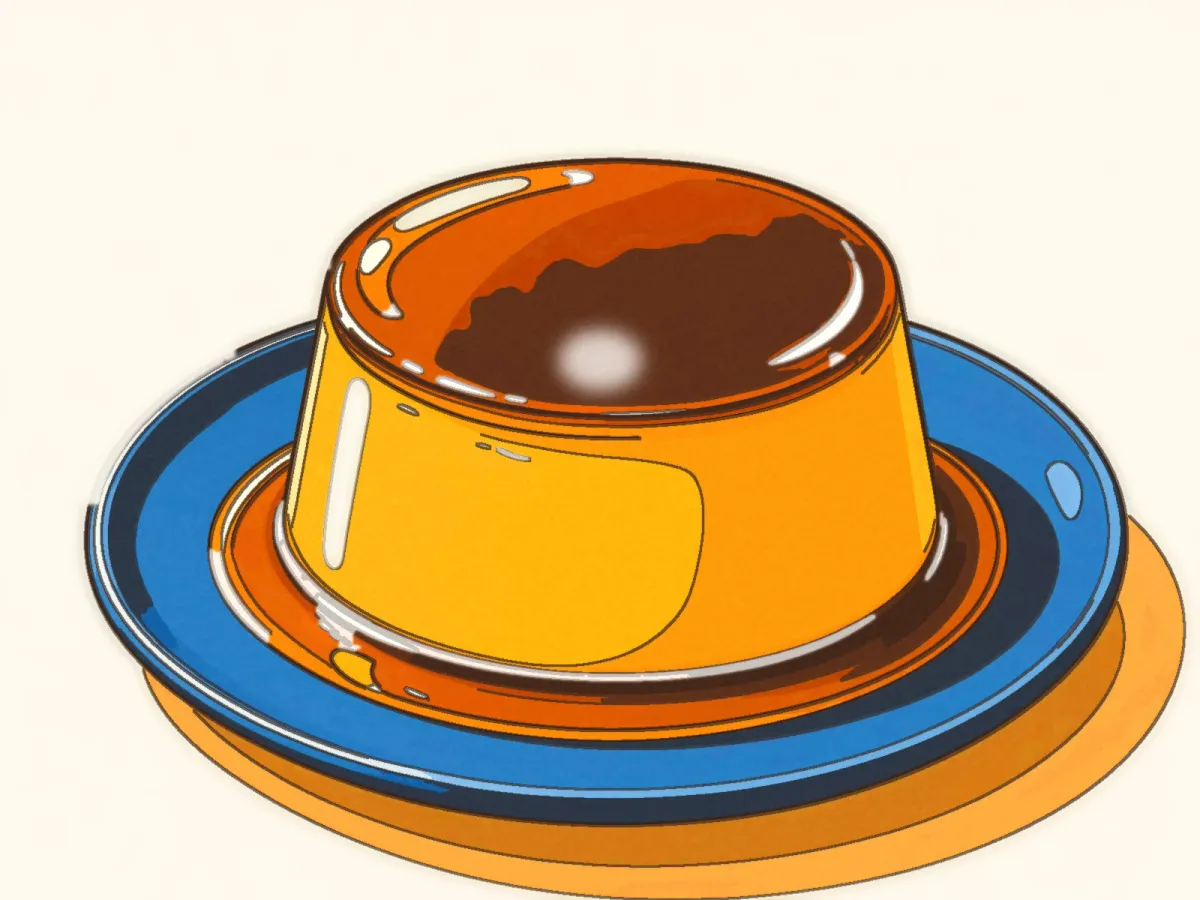
At Bulma's birthday party, Beerus, the God of Destruction, loses his temper when Buu refuses to share a pudding with him (at the same party he also tries takoyaki).
Beerus's Pudding
Little Japanese custard puddings (purin), wobbly and topped with dark caramel: so good that nobody would want to share them.
approx. 230 kcal · light bite
1 h + 3 h de nevera · base recipe for 4 servings
Beerus's Pudding
Caramel
- 60 g sugar and 20 ml water (plus 15 ml hot water)
Custard
- 400 ml whole milk
- 3 eggs (165 g)
- 60 g sugar
- 1 tsp vanilla extract
- 1 liter water for the bain-marie
Get ready
- Wash your hands with warm water and soap and dry them well. Wash them again every time you touch the eggs in their shells.
- Take the 3 eggs out of the fridge 20 minutes ahead, so they are not ice-cold when you whisk them with the warm milk.
- Gather 4 ramekins or individual molds of about 150 ml, clean and dry (any moisture makes the caramel spit), and set them in a deep oven tray big enough to hold them in a bain-marie.
- Weigh 60 g of sugar and measure 20 ml of water for the caramel into a small, light-bottomed saucepan so you can see the color. Separately, have 15 ml of hot water ready in a cup.
- Measure the 400 ml of whole milk and weigh the 60 g of sugar for the custard. Keep the vanilla handy: 1 tsp of extract.
- Bring a liter of water to the boil in a kettle or saucepan for the bain-marie. Have foil, a pitcher, a fine sieve and a clean dish towel ready.
- Clear a space in the fridge where the 4 ramekins can sit level.
Tools
- Small light-bottomed saucepan for the caramel
- Medium saucepan for warming the milk
- 4 ramekins or individual molds of about 150 ml
- Deep oven tray (for the bain-marie)
- Large bowl and a hand whisk or fork
- Pitcher
- Fine sieve
- Aluminum foil
- Measuring spoons and kitchen scale
- Kettle or saucepan for the bain-marie water
- Oven gloves and tongs
- Clean dish towel
- Thin round-tipped knife and a flat plate for turning out
- Clock or timer
Steps
- Preheat the oven to 150 °C (300 °F), top and bottom heat, with the rack in the middle. Bring the liter of water for the bain-marie to the boil.An oven that has already settled at temperature keeps the pudding from getting a sudden blast of heat.
- Place the well-dried ramekins in the deep tray and leave the tray near the stove, on a board or trivet, so you can pour the caramel without moving around.
- Put the 60 g of sugar and the 20 ml of water in the small saucepan. Swirl the pan to wet all the sugar, but don't stir it with a spoon. Heat over medium heat until the sugar dissolves and the liquid turns clear, about 3 minutes.If you stir with a spoon, the sugar crystallizes and turns lumpy.
- Keep going over medium heat, without stirring, for another 5–7 minutes. The liquid will form big bubbles and start turning golden at the edges. Swirl the pan gently when one side darkens. Take it off the heat when it is a dark amber color, like strong tea, and smells toasty, not burnt. If you see dark smoke, it has burnt: start again.Caramel gets hotter than 160 °C: don't touch it, don't taste it and keep children away. It is normal for the color to change quickly at the end.
- Take the pan off the heat. With your arm outstretched and your face well back, carefully add the 15 ml of hot water: it will spit and bubble fiercely. Swirl the pan until the caramel is fluid and smooth.The hot water stops the caramel from setting rock-hard and leaves a runny sauce when you turn the puddings out.
- Share the caramel straight away between the 4 ramekins, a tablespoon in each (about 20 g). Tilt each ramekin to coat the bottom before it hardens.Leave hot water in the saucepan so the caramel dissolves and it cleans itself.
- Warm the 400 ml of whole milk with the 60 g of sugar in the medium saucepan over medium-low heat, stirring, until the sugar dissolves (about 3 minutes) and steam rises from the surface. It must not boil: take it off the heat if big bubbles appear.If the milk boils, the skin on top splits and the pudding turns out lumpy.
- Crack the 3 eggs one at a time into a large bowl, checking that no bits of shell fall in. Throw away any cracked eggs before breaking them and wash your hands with soap.
- Beat the eggs with the whisk or a fork in back-and-forth strokes, without lifting it out of the bowl, until you can't tell yolks from whites and there is no foam.Foam leaves holes in the pudding; if bubbles appear, skim them off with a spoon.
- Pour the warm milk over the eggs in a thin stream, whisking all the time, so the heat doesn't set the egg into lumps.If the egg sets into strands, the milk was too hot: let it cool a little before pouring.
- Add the teaspoon of vanilla extract and stir gently.
- Strain the mixture through the fine sieve into the pitcher. Skim the bubbles off the surface with a spoon.The first straining catches any bits of egg white that didn't mix in.
- Strain it again, from the pitcher into the clean bowl and back into the pitcher, for a really smooth texture.Straining twice is the secret to a silky pudding.
- Use the pitcher to pour the custard into the 4 ramekins in a gentle stream against the side of each mold, so you don't disturb the caramel. Leave about 150 ml in each, a finger's width below the rim. Pop any bubbles that appear with a spoon.Any bubbles left behind turn into holes in the oven.
- Cover each ramekin with a piece of foil, sealing the edge well. This stops a skin forming and keeps water from the bain-marie dripping in.
- Pull the oven rack halfway out and set the tray on it. Carefully pour boiling water into the tray until it comes halfway up the ramekins, without splashing the custard. Gently slide the rack back into the oven.Do this with the rack pulled out so you don't spill boiling water while moving the tray.
- Bake for 35–40 minutes. The pudding is ready when the edges are set and the center wobbles like jelly when you gently shake the tray (if you have a thermometer, 80–82 °C in the center). If the water in the bain-marie is boiling hard or the pudding puffs up like a soufflé, it is overcooking.Overcooked pudding is full of holes and tastes of boiled egg.
- Wearing oven gloves, take out the tray. Leave the ramekins in the water for 10 minutes and carefully remove the foil: the steam burns. Then lift them out with tongs or the dish towel and set them on a rack.
- Let the ramekins cool for 30 minutes at room temperature. Then refrigerate them, covered, for at least 3 hours, until they are thoroughly cold and firm. Don't leave them out of the fridge for more than 2 hours.Once cold, the pudding turns out cleanly and the caramel melts into a sauce.
- Run a thin knife all the way round each ramekin, pressed against the side, to loosen the pudding. Cover the ramekin with a flat plate and flip it over in one firm movement, holding plate and mold together. Wait 10 seconds and slowly lift off the ramekin.If it won't come out, dip the base in hot water for 10 seconds and try again. The caramel will run down over the top.
- Serve the pudding cold, on its plate, with the caramel on top. Keep it in the fridge and eat it within 3 days.
Allergens
Contains: huevo, lácteos.
A guide only; always check the label.
Sin verificar. La fuente identifica el postre como pudin de crema (custard pudding, estilo flan japonés «purin»); la receta concreta es interpretación propia. El takoyaki no se incluye en esta receta.
Azúcar alto. La ración concentra bastante azúcar.
Per serving, approx.
Energy · 230 kcal
Week menu
Put this dish on a lunch or a dinner. The combined list adds up the whole menu.
Notes
El agua del baño maría (1 l) figura ahora como línea de ingredientes en la original, la ligera y la sin gluten; el agua de las demás líneas es solo la del caramelo. Solo la original lleva en su línea los 15 ml de agua caliente del caramelo; en la ligera, la sin gluten y la vegana el caramelo se reparte sin añadir esa agua. La vegana no usa baño maría.
La vainilla de la ligera ahora se llama «1 cucharadita de extracto de vainilla», como en la original (sin kcal ni alérgenos relevantes); la sin gluten acepta extracto con sello o vaina.
Flan listo: borde cuajado y centro que tiembla como gelatina; si tienes termómetro, 80–82 °C. El huevo cuaja del todo; no hay yema cruda.
En la ligera, el caramelo es fino (30 g de azúcar) y se reparte en una cucharadita por flanera; el eritritol solo se usa en la crema, no en el caramelo.
En la vegana, el agar debe hervir 2 minutos para cuajar y se añade en frío a la bebida; la bebida de soja se desborda con facilidad al hervir. Se cuaja en la nevera; no se hornea.
El caramelo de las cuatro fichas se hace en un cazo claro, sin remover, y no se prueba.
Passport
Mark it when you cook it. If you upload a photo, the stamp is sealed.
In other kitchens
No notes yet. The first one can be yours.