
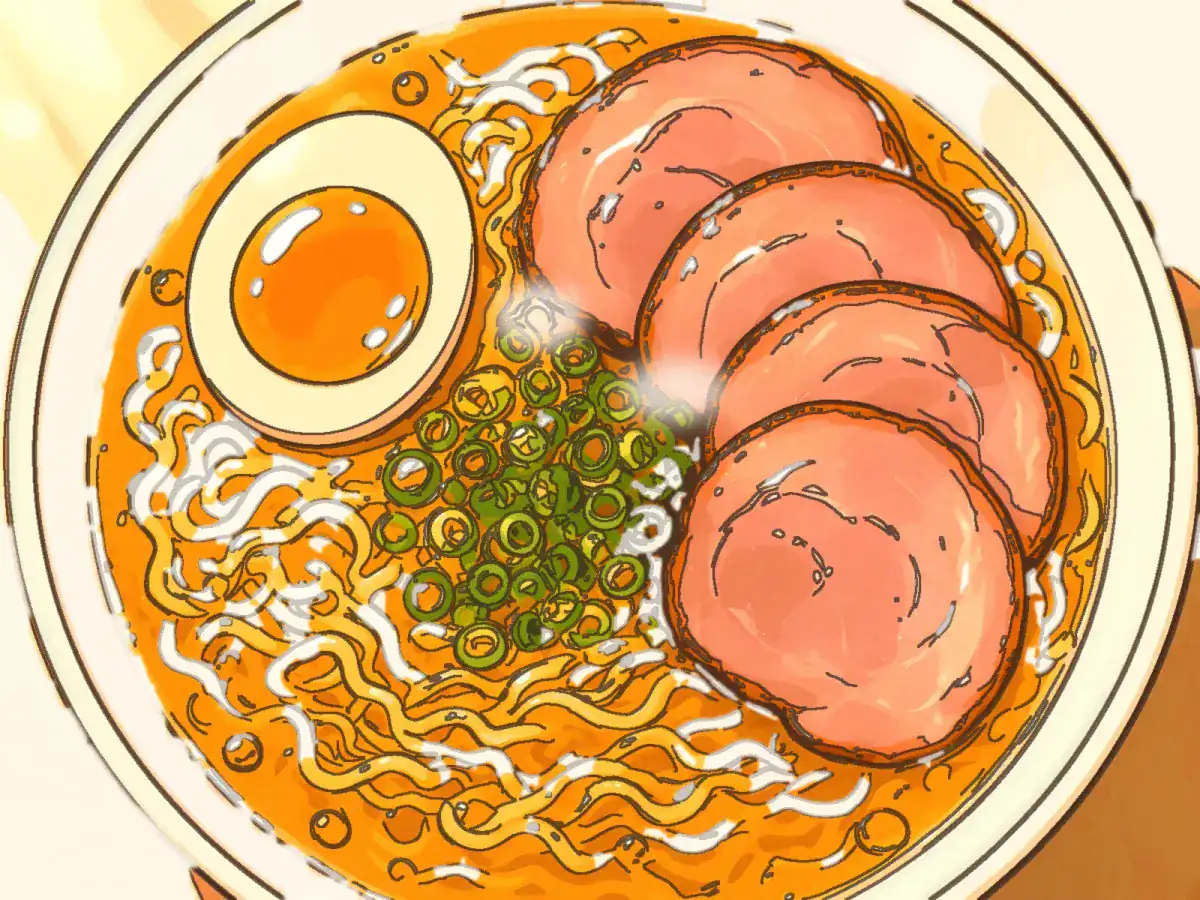
In the film, on a stormy night, Lisa makes ramen with ham, egg and scallion for Sosuke and Ponyo.
Ponyo's Ramen
Noodles in hot broth with thick slices of ham, egg and scallion, ready in twenty minutes: the perfect bowl for a rainy night.
approx. 515 kcal · midday plate
20 min · base recipe for 2 servings
Ponyo's Ramen
Ingredients
- 160 g dried ramen-style wheat noodles
- Water, as needed (for cooking the eggs, noodles and spinach, and for the ice bath)
- 800 ml homemade unsalted chicken stock
- 30 ml soy sauce
- 10 ml mirin
- 5 ml toasted sesame oil
- 80 g cooked ham in 2 thick slices
- 2 eggs (110 g without shell)
- 60 g fresh spinach
- 20 g scallion (spring onion), thinly sliced into rings
Get ready
- Wash your hands before and after handling the eggshells.
- Set out a bowl of ice-cold water and ice cubes to cool the eggs (the ice is mise en place, not an ingredient on the card).
- Take the chicken stock out so it isn't fridge-cold. Measure the soy sauce, mirin and sesame oil into separate small bowls.
- Wash the spinach and scallion. Have two large deep bowls ready, plus two plates to cover them at the end.
- If the ham doesn't come in thick slices, cut it now into two pieces almost 1 cm thick.
Tools
- Small saucepan for the eggs
- Pot for the broth and pot for the noodles (or the same one, in turns)
- Colander and slotted spoon
- Bowl for the ice bath
- Knife and clean cutting board
- Two deep bowls and two plates to cover them
- Timer and measuring spoons
Steps
- Fill a saucepan with water and bring it to a hard boil over high heat: big, steady bubbles across the whole surface.Use a saucepan that fits both eggs in a single layer.
- Lower the eggs in with a slotted spoon and cook them for exactly 7 minutes at a steady boil (medium-high heat if needed to keep it going).This timing leaves the yolk creamy, not dry. If the eggs are very cold from the fridge, lower them in gently so the shells don't crack.
- Move them to the ice bath for 2 minutes, until the shells feel cold. Peel them carefully, starting at the wider end (that's usually where the air pocket is), and set them aside whole. Wash your hands.The cold shock stops the cooking and makes peeling easier.
- Slice the scallion into thin 2 mm rings, keeping your fingers tucked in a claw grip. Set aside.
- If needed, cut the cooked ham into 2 thick slices almost 1 cm thick; keep them whole, not in thin strips: in the bowl they should look like two pink tiles.
- Put the chicken stock in a pot with the soy sauce and mirin. Heat over medium heat until it reaches a gentle simmer: small, steady bubbles around the edge, without churning. Taste and keep hot over very low heat.The broth needs no extra salt: the soy sauce seasons it.
- In another pot, boil water and cook the noodles according to the package, until flexible and al dente. Drain them.Don't leave them sitting in the water: they overcook and stick together.
- In the same noodle water, or in a saucepan of boiling water, dip the spinach in for 30 seconds, until bright green and floppy. Drain and squeeze lightly to remove the excess water.Half a minute is enough: any longer and it turns drab and brownish.
- Divide the noodles between two deep bowls and cover with the hot broth, until the strands are submerged with a little clear broth floating above.
- Add a few drops of toasted sesame oil to each bowl (split the 5 ml) and take a sniff: it should smell of freshly toasted sesame.A few drops are enough; too much masks the flavor of the broth.
- Cut each egg in half lengthwise (the yolk should look creamy) and top each bowl with the ham, the two egg halves, the spinach and the scallion rings.
- Cover each bowl with a plate for 1 minute so the steam warms the ham and takes the chill off the egg, and uncover them at the table.It's the stormy-night touch: the plate keeps the heat in until everyone sits down.
Allergens
Contains: gluten, huevo, soja, sésamo.
May contain: lácteos, apio, sulfitos.
A guide only; always check the label.
Deja parte del caldo. En este plato, alrededor del 65 % de la sal está en el caldo (salsa de soja, miso, sal o caldo). Si te lo tomas todo, la ración aporta unos 4,3 g de sal (aprox.); si dejas en el cuenco un tercio del caldo, baja a unos 3,4 g (aprox.). Como referencia, la OMS recomienda no pasar de 5 g de sal al día en adultos. Disfruta de todo lo sólido y bebe el caldo a sorbitos, sin prisa.
Per serving, approx.
Energy · 515 kcal
Week menu
Put this dish on a lunch or a dinner. The combined list adds up the whole menu.
Notes
El agua de cocción de huevos, fideos y espinacas y el baño de hielo figuran ahora como línea de ingredientes («Agua, la necesaria (...)»); los cubitos de hielo se tratan como mise en place.
Huevos a 7 minutos: yema cremosa. Quien necesite la yema más cuajada puede alargar un poco; no se ha cambiado el tiempo aprobado.
En la vegana, el kombu, el agua y las shiitake secas viajan en una sola línea de la ficha.
Passport
Mark it when you cook it. If you upload a photo, the stamp is sealed.
In other kitchens
No notes yet. The first one can be yours.