
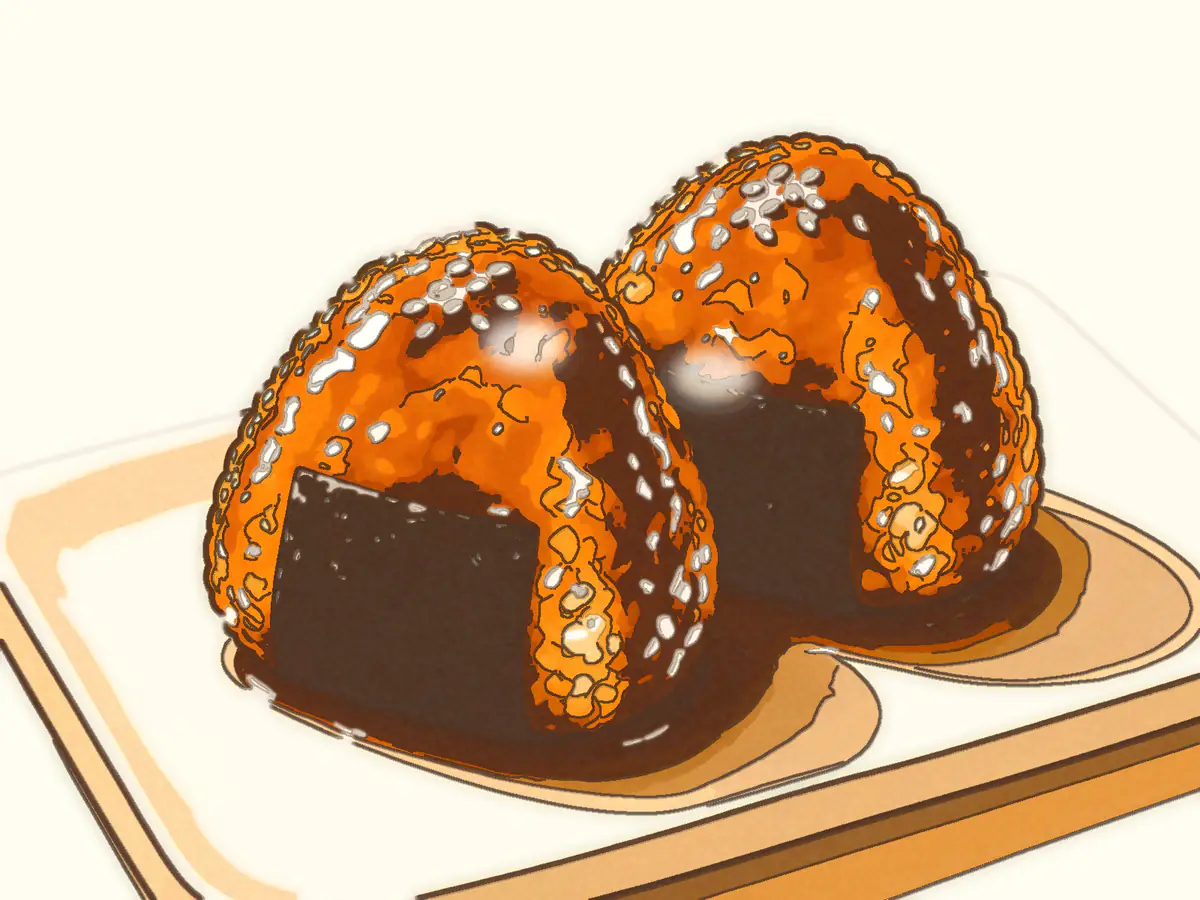
In the Hashira Training arc, onigiri are grilled during a break outdoors.
Onigiri dorados en una parrilla de campamento; sin detalles del entrenamiento.
Demon Slayer Yaki Onigiri
Toasted rice triangles brushed with soy sauce: yaki onigiri are grilled Japanese rice balls, crisp outside and tender inside.
approx. 610 kcal · midday plate
30 min · base recipe for 2 servings
Demon Slayer Yaki Onigiri
Ingredients
- 300 g Japanese short-grain rice (uncooked)
- 390 ml water for cooking the rice
- 30 ml soy sauce
- 10 ml mirin
- 5 ml toasted sesame oil
- 10 g butter (to finish)
Get ready
- Wash your hands with soap and water.
- Measure out 390 ml of water for the rice, and 30 ml of soy sauce and 10 ml of mirin into a small bowl (the salt for your hands isn't on the ingredient list).
- Weigh out 300 g of uncooked Japanese rice and 10 g of butter. Measure 5 ml of sesame oil.
- Set up a bowl of water with a pinch of salt for wetting your hands; keep a pastry brush and a wet rice paddle handy.
- Clear a wide tray for cooling the rice and a plate for the shaped onigiri.
Tools
- Saucepan with a lid
- Sieve and large bowl
- Rice paddle
- Wide tray
- Small bowl with a fork
- Bowl of salted water
- Pastry brush
- 28 cm nonstick frying pan
- Wide spatula
- Paper towels and a plate
Steps
- Wash the 300 g of rice in a bowl of cold water, swirling it with your hand and changing the water 3 or 4 times, until it runs almost clear. Tip it into a sieve and let it drain for 10 minutes.Washing removes the surface starch, so the grains stay separate but sticky when you shape them.
- Put the rice in a saucepan with the 390 ml of cold water. Cover and bring to a boil over medium-high heat (the lid rattles and steam peeks out). As soon as it boils, turn the heat down to the lowest setting.Measure the water with a measuring cup so the rice comes out just right.
- Cook over the lowest heat for 12 minutes without lifting the lid. Turn off the heat and let it rest, covered, for 10 more minutes.Don't lift the lid while it cooks: the steam is what cooks the grain.
- Uncover and fluff the rice with a wet paddle, cutting crosswise without squashing it. It should look glossy and plump, with no water left at the bottom. Spread it out on a wide tray.Spreading it on a tray cools it faster and makes it easier to handle.
- Let the rice cool for 8 minutes, until it's hot but you can touch it without burning yourself (about 60 °C).If it burns when you touch it, wait 2 more minutes: otherwise you'll burn yourself and squeeze too hard.
- In a bowl, mix the 30 ml of soy sauce and 10 ml of mirin. Stir for 20 seconds with a fork.This mixture is the glaze: it should be runny and chestnut brown.
- Set up a bowl of water with a pinch of salt. Wet your hands, shake them off a little and rub them with 2 or 3 grains of salt. They should be damp, not dripping.The water stops the rice from sticking to your skin; the salt seasons the surface. If the rice sticks to your fingers, wet them again.
- With damp hands, take a quarter of the rice (about 180 g cooked) and place it in the palm of one hand. Close your fingers and start shaping it into a ball.Divide the rice by eye into four equal piles before you start.
- With your other hand in a “V” shape, form three sides and press gently three times, turning the rice a third each time, until you have a compact, firm triangle about 2.5 cm thick. Don't squash it: it shouldn't break when you touch it.Pressing firmly matters, because it's going to be flipped in the pan. If it cracks, wet your hands and press again.
- Repeat with the other three piles, wetting your hands each time, until you have 4 onigiri. Leave them on a plate, not touching, for 5 minutes so they settle and dry slightly on the outside.An onigiri with a slightly dry surface browns better.
- Heat a 28 cm nonstick frying pan over medium heat for 1 minute. Add the 5 ml of sesame oil and spread it with a paper towel. It should smell of toasted sesame, without smoking.Toasted sesame oil burns quickly: medium heat, never high.
- Place the 4 onigiri in the pan on one of their flat sides, not touching. Cook for 3 minutes without moving them over medium heat, until a golden crust forms and you hear a gentle sizzle.Don't move them too soon: the crust forms on its own and releases without breaking.
- Turn them over with a wide spatula, resting one hand on top. Cook the other side for 3 minutes, until it's also golden and firm.
- With a pastry brush, paint the top side with a thin layer of the soy and mirin mixture, over medium-low heat. Wait 30 seconds, until it bubbles and turns glossy.A thin layer: if you add too much, the rice gets soggy and breaks.
- Flip the onigiri again and brush the other side with sauce. Cook for 30–40 seconds, until the glaze darkens to a glossy mahogany and smells like caramel.Keep an eye on it: the sugars in the mirin burn fast. If it smells burnt, turn the heat down and take them off right away.
- Stand each triangle on one of its short sides to brown an edge: 30 seconds per side, brushing glaze over the top, until they're golden and glazed too.
- Brush a second thin coat of glaze on all sides, without soaking it, and cook for 30 more seconds over low heat until the glaze is sticky and glossy.Two thin coats stick better and don't make the rice soggy.
- Take the pan off the heat. Add the 10 g of butter at the edge of the pan and leave it for 10 seconds to melt. Turn the onigiri in it.The butter goes in at the end, off the heat, so it doesn't burn.
- Serve the onigiri straight away, hot, with a crisp crust outside and tender rice inside. Let them sit for 2 minutes so they don't burn your mouth.They're eaten by hand, best freshly made.
Allergens
Contains: gluten, soja, lácteos, sésamo.
May contain: sulfitos.
A guide only; always check the label.
Per serving, approx.
Energy · 610 kcal
Week menu
Put this dish on a lunch or a dinner. The combined list adds up the whole menu.
Notes
El agua del arroz (390 ml para 300 g; 325 ml para 250 g) figura ahora como línea de ingredientes; la sal de las manos sigue sin figurar como ingrediente.
300 g de arroz crudo dan unos 750 g cocidos: cada onigiri pesa unos 180 g (155 g en la ligera), bastante grande; se avisa de formarlos firmes y de 2,5 cm de grosor para que no se rompan en la sartén.
Original y sin gluten llevan mantequilla (10 g) al final, fuera del fuego; la ligera y la vegana no.
La ficha ligera usa «5 ml de aceite» sin especificar sésamo: se usa aceite neutro.
En la sin gluten, tamari y mirin deben llevar sello sin gluten.
No se añade ningún ingrediente nuevo ni cantidad nueva.
Passport
Mark it when you cook it. If you upload a photo, the stamp is sealed.
In other kitchens
No notes yet. The first one can be yours.