
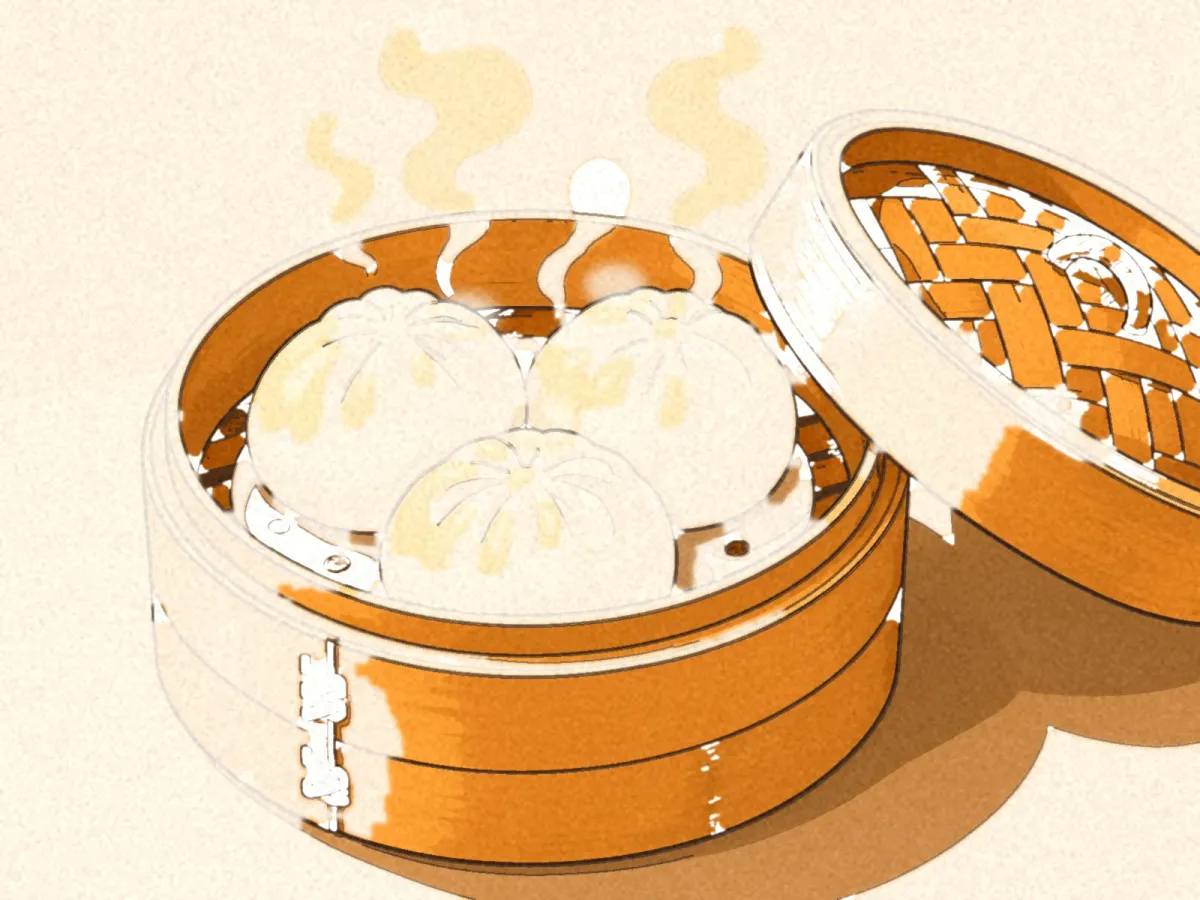
After a hard shift at the bathhouse, a coworker shares warm steamed buns with the main character. Japanese food articles identify them as anman (buns filled with sweet azuki bean paste); the film's dialogue never names the filling out loud.
Un bollo al vapor compartido en un momento de calma; sin spoilers del banquete ni del resto de la trama.
Chihiro's Anko Steamed Buns
Fluffy dough with a sweet azuki filling: anman are steamed buns filled with anko (sweet red bean paste), and every bite tastes like a well-earned break.
approx. 220 kcal · light bite
2 h 30 min (45 min activos) · base recipe for 8 servings
Chihiro's Anko Steamed Buns
Ingredients
- 250 g plain (all-purpose) wheat flour
- 50 g sugar
- 5 g dried yeast
- 5 g oil
- 140 ml lukewarm milk
- 1 g salt
- 240 g anko (sweet azuki bean paste)
- Water, as needed (3–4 cm in the pot, for steaming)
Get ready
- Wash your hands with warm water and soap and dry them well.
- Weigh everything and put each item in its own bowl: 250 g flour, 50 g sugar, 5 g yeast, 5 g oil, 1 g salt and 240 g anko.
- Measure 140 ml of milk into a glass: you'll warm it in the first step.
- Cut 8 squares of baking paper, 8 × 8 cm.
- Check that the steamer fits on the pot and that the water won't touch the bottom of the steamer.
- Clear the countertop and clean it well: you'll work the dough directly on it.
- Have a clean dish towel and plastic wrap ready.
Tools
- Kitchen scale
- Large bowl for the dough
- Small bowl for activating the yeast
- Spatula or wooden spoon
- Fork
- Clean dish towel and plastic wrap
- Bench scraper or chef's knife
- Small rolling pin (optional)
- Bamboo steamer with lid (or a pot with a rack and lid)
- 8 × 8 cm squares of baking paper
- Pot holders or oven mitts
- Timer
Steps
- Measure 140 ml of milk and warm it over low heat (or for 20 seconds in the microwave) until lukewarm, about 38 °C. Test a drop on the inside of your wrist: it should feel lukewarm, neither cold nor hot.Above 45 °C the yeast weakens and the dough won't rise. If in doubt, slightly cool is better than too hot.
- Pour the warm milk into a small bowl. Add 1 tsp (about 5 g) of the 50 g of sugar and the 5 g of dried yeast. Stir for 20 seconds with a teaspoon.Keep the rest of the sugar (about 45 g) for the dough: don't add it all here.
- Leave the mixture to stand for 5 minutes without touching it. It's ready when the surface is covered in a creamy foam and smells like bread. If there's no foam, the yeast is out of date: start again with fresh yeast.Put it somewhere free of drafts; yeast works best at around 25 °C.
- In the large bowl, mix the 250 g of flour, the remaining 45 g of sugar and the 1 g of salt with a fork for 20 seconds to spread the salt evenly.Salt in direct contact with yeast slows it down: that's why it goes in with the flour and not in the foamy bowl.
- Make a well in the center of the flour. Pour in the foamy yeast milk and the 5 g of oil. Stir with the spatula from the center outward until there's no dry flour left and you have a rough dough.
- Tip the dough onto the clean countertop and knead it for 8 minutes: push it away with the heel of your hand, fold it back toward you, give it a quarter turn and repeat. It's sticky at first; don't add flour, it gets smoother every minute.If it sticks a lot to your fingers, wet them with a few drops of water, not flour: the card doesn't include extra flour.
- Check the kneading: pinch off a piece and stretch it with your fingers; it should form a thin, almost translucent sheet without tearing. When you poke it with a finger, the dough springs back slowly. If it tears, knead for 2 more minutes.
- Shape it into a smooth ball and place it seam-side down in a clean bowl. Cover with plastic wrap or a damp towel and leave it to rise for 1 hour somewhere warm (25–28 °C, for example in the oven switched off with the light on), until doubled in size.Mark the starting height with a rubber band around the bowl: that way you can see when it has risen enough.
- While the dough rises, weigh out 8 portions of 30 g of anko and roll each one into a smooth ball about 3 cm across. If the anko sticks to your palms, wet them lightly. Cover the balls with plastic wrap so they don't dry out.
- When the dough is ready, press a finger into it 2 cm deep: if the hole doesn't fill back in, it's ready. Knock it back by gently sinking your fist into the center to push out the big bubbles.
- Move the dough to the clean countertop and roll it into an even log about 30 cm long and 4 cm wide.
- Cut the log into 8 pieces with the bench scraper, about 56 g each. Weigh them and adjust by removing or adding a pinch so they're all equal. Cover the pieces with a towel.A bench scraper gives a clean cut; a knife tends to drag the dough.
- Take one piece and flatten it with your palm. Use your fingers or a small rolling pin to make a 9–10 cm disc: thicker in the center (about 5 mm) and thinner at the edges (2 mm), so the dough doesn't bunch up on top when you close it.
- Place a 30 g ball of anko in the center of the disc.
- Hold the disc in one hand and with the other pinch the edge, lifting it and making small pleats around the anko until it closes at the top. Twist the join and pinch to seal it well: there should be no gaps.If it opens, wet your finger with a drop of water and pinch again.
- Place the bun seam-side down on a square of baking paper. Repeat with the other 7 pieces of dough and the remaining 7 balls of anko.
- Put the buns on their paper in the steamer, leaving 4–5 cm between them so they can grow. Cover them with a towel and let them rest for 20 minutes, until they look puffy and feel soft.
- While they rest, pour 3–4 cm of water into the pot (it mustn't touch the bottom of the steamer) and bring it to a rolling boil over high heat, until there's plenty of steady steam.
- Set the steamer on the pot, cover it (with a towel wrapped around the lid so it doesn't drip) and turn the heat down to medium-high. Steam for 12–15 minutes without lifting the lid. They're done when they're very puffy, smooth and shiny and spring back when you press them gently.The steam should come out steadily but without boiling over. If the water gets too low, top it up with hot water.
- Turn off the heat and wait 2 minutes before uncovering, so they don't wrinkle from the sudden change in temperature. Lift the lid tilted away from your face and keep your hands away from the steam.Steam burns more than boiling water: use pot holders.
- Take the steamer off with oven mitts and let the buns cool for 5 minutes. Before eating, check that the anko is piping hot inside: break one in half; the filling should be steaming and the dough should look fluffy, with no damp patches.Anko holds its heat for a long time; bite carefully and let it cool a little.
Allergens
Contains: gluten, lácteos.
A guide only; always check the label.
Sin verificar. El relleno no se nombra en el diálogo; la identificación como anman/anko proviene de artículos gastronómicos (p. ej. Tofugu, Dazed), no de una línea de guion.
Per serving, approx.
Energy · 220 kcal
Week menu
Put this dish on a lunch or a dinner. The combined list adds up the whole menu.
Notes
Original: 8 bolas de anko de 30 g (240 g en total), como indica la ficha.
Ligera: menos azúcar y anko (8 bolas de 20 g) con leche semidesnatada; la masa lleva menos harina para el mismo líquido y queda más blanda.
Sin gluten: la masa se mezcla sin amasar y se cierra con film; fichas con aviso de altramuces y trazas en el anko.
Vegana: bebida de soja en lugar de leche; revisar que el anko no lleve gelatina ni miel.
El agua de la vaporera (3–4 cm en la olla) figura ahora como línea de ingredientes en las cuatro fichas.
Passport
Mark it when you cook it. If you upload a photo, the stamp is sealed.
In other kitchens
No notes yet. The first one can be yours.