
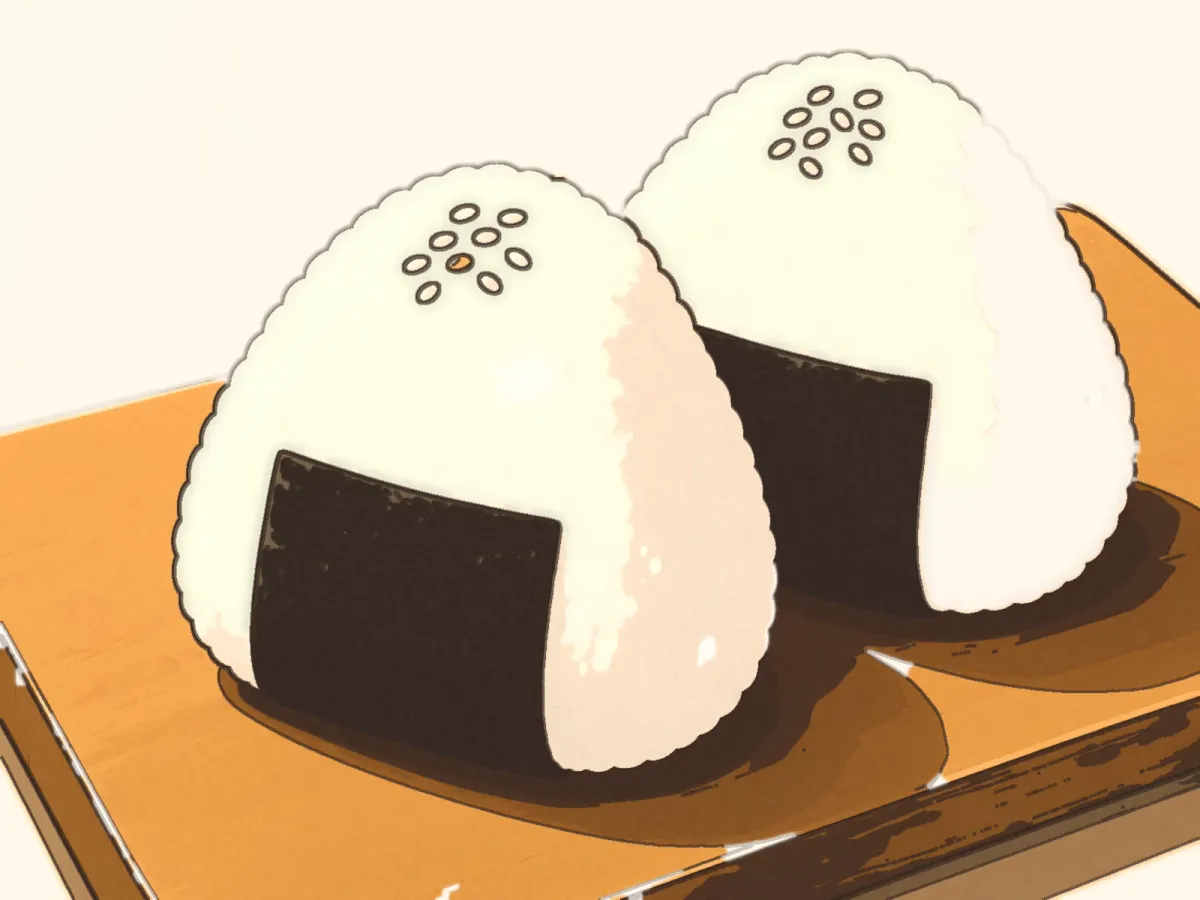
In the film, Haku gives Chihiro some rice balls at dawn, and she eats them in tears after an exhausting day.
Haku's Onigiri
Warm, lightly salted rice balls with a salmon heart: a simple bite that comforts you on the hard days.
approx. 535 kcal · midday plate
40 min · base recipe for 2 servings
Haku's Onigiri
Ingredients
- 240 g Japanese short-grain rice
- 310 ml water for cooking the rice
- 100 g fresh salmon
- 2 g salt (for your hands and the salmon)
- 6 strips of nori seaweed (6 g; optional)
Get ready
- Wash your hands. Wash them again after touching the raw salmon.
- Measure out 240 g of rice and have 310 ml of water ready to cook it.
- Preheat the oven to 200 °C (400 °F) once the rice is on, or a little earlier if you are short on time.
- Cut 6 strips of nori as wide as the base of an onigiri (optional). Set aside 2 g of salt for your hands and a pinch to sprinkle on the salmon.
- The salmon filling is our own addition to this recipe, not a literal scene from the film.
Tools
- Saucepan or rice cooker, and a sieve
- Small baking sheet or frying pan for the salmon
- Baking paper or paper towels
- Bowl of water for wetting your hands
- Chopping board and fork
- Six nori strips ready, or scissors to cut them
- Timer
Steps
- Put the rice in a sieve and wash it under cold water, stirring, until the water runs almost clear. Let it drain for a couple of minutes.The extra starch makes the grains gluey, and then it is hard to shape triangles that don't stick too much.
- Cook it with 310 ml of water: cover, bring to a boil over medium-high heat and, as soon as it boils, turn the heat down to low for 12 minutes without lifting the lid. Turn off the heat and let it rest, covered, for 10 minutes. Fluff with a paddle, without squashing.The grains should look plump, tender and shiny, not hard in the middle or mushy.
- Put the fresh salmon on a small tray, sprinkle on a pinch of the 2 g of salt and bake at 200 °C (400 °F) for 8 minutes. It is ready when the flesh turns opaque, flakes into layers, and no longer looks raw or translucent in the center.A thin fillet may be done in 7 minutes; if it is thick, poke the center. The fish must not be left raw.
- Flake the salmon with a fork into small pieces, removing any skin or bones. Set aside.Let it cool a little: a boiling-hot filling opens up the rice and makes the onigiri hard to close.
- Prepare a bowl of cold water. Wet your hands, shake them off and rub them with a little of the remaining salt: they should be damp and only lightly salted, not caked in salt.The water stops the rice sticking to your skin and the salt seasons the outside. If you overdo the salt, the first onigiri will be too strong: use a pinch.
- Take a sixth of the still-warm rice (about 80–90 g cooked, by eye). Shape it into a ball, make a hollow with your thumb, put in a teaspoon of salmon and close the rice around it, leaving no filling showing.If the rice is too hot, wait a couple of minutes: otherwise you will burn your hands and squeeze too hard.
- With both hands, shape it into a triangle (or a ball, if that is easier): press gently but firmly, turning it a little each time, until it holds together on its own and has smooth sides. Don't flatten it like modelling clay: it should be compact but tender.If it splits, wet your hands again, add a little rice into the crack and press again.
- Repeat until you have 6, wetting and salting your hands whenever the rice starts to stick. Wrap the base of each onigiri with a strip of nori just before eating, so the seaweed stays crisp.If you put the nori on too early, it goes soft from the moisture in the rice. The nori is optional: without it the onigiri hold together just the same.
Allergens
Contains: pescado.
A guide only; always check the label.
Sin verificar. Sin verificar (no usado): que Haku pusiera un hechizo en las bolas de arroz. En la película las bolas parecen sencillas; el relleno de salmón es un añadido propio.
Per serving, approx.
Energy · 535 kcal
Week menu
Put this dish on a lunch or a dinner. The combined list adds up the whole menu.
Notes
El agua de cocción del arroz (310 ml para 240 g; 210 ml para 160 g) y la del edamame figuran ahora como líneas de ingredientes.
El relleno de salmón es un añadido propio; en la película las bolas parecen sencillas. La nota de escena sobre un hechizo no se usa.
En la versión sin gluten el nori debe ser natural, sin sazonar.
En la ligera el edamame se mezcla con el arroz y el atún va de relleno; el atún se usa bien escurrido.
Passport
Mark it when you cook it. If you upload a photo, the stamp is sealed.
In other kitchens
No notes yet. The first one can be yours.