
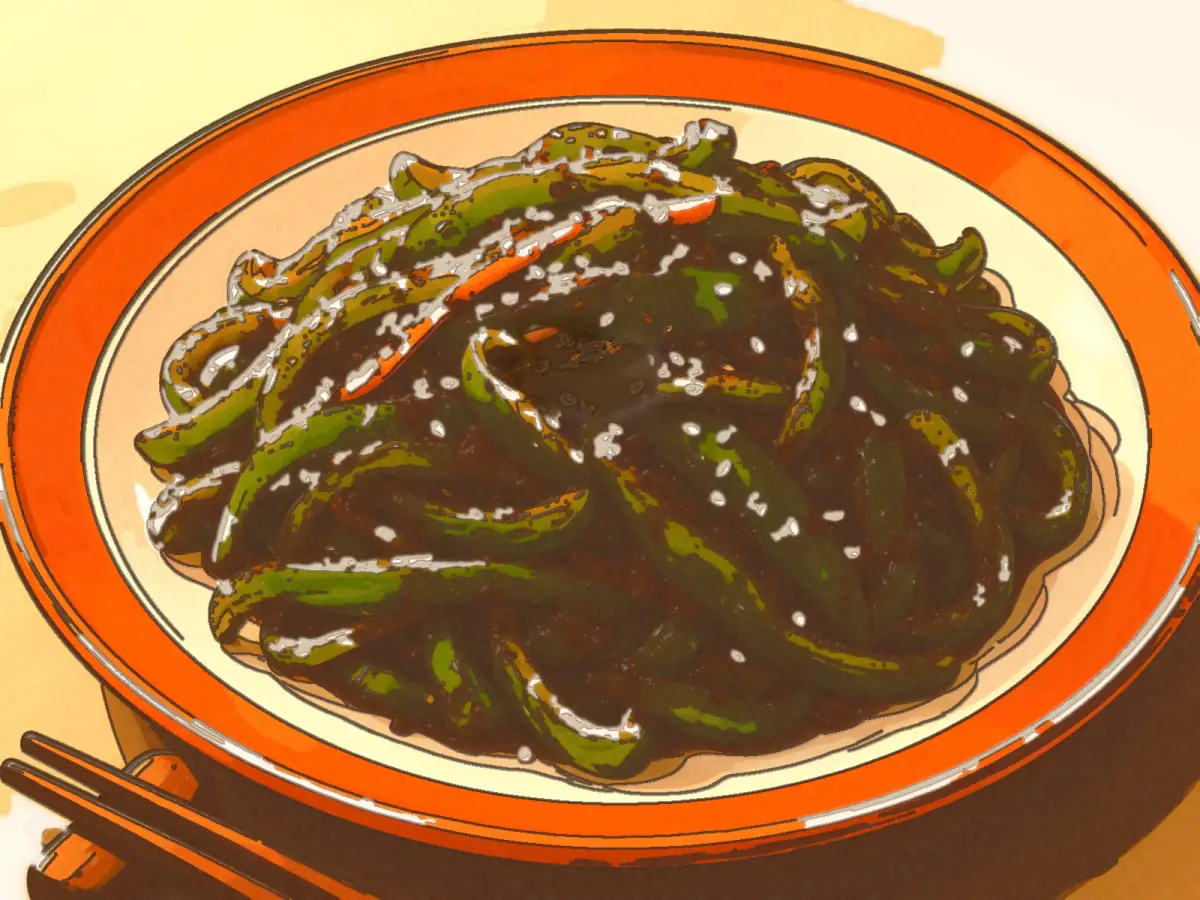
In the first episode, on board the ship, someone makes chinjao rosu (stir-fried peppers) without any meat because the budget won't stretch; even so, it's announced as “with beef”.
Un salteado cotidiano a bordo, sin spoilers de cazarrecompensas.
Cowboy Bebop Bell Peppers “with Beef”
Bell peppers, bamboo shoots and mushrooms in a glossy sauce: a riff on chinjao rosu (Japanese-Chinese pepper stir-fry), the home cooking of tight-budget days.
approx. 780 kcal · Sunday spread
25 min · base recipe for 2 servings
Cowboy Bebop Bell Peppers “with Beef”
Ingredients
- 400 g green bell pepper, cut into strips
- 100 g canned bamboo shoots, cut into strips
- 100 g fresh shiitake mushrooms
- 50 g scallions (spring onions)
- 10 g fresh ginger, cut into strips
- 20 ml oil
- 30 ml soy sauce
- 15 ml sake
- 10 ml mirin
- 5 g sugar
- 5 g cornstarch (cornflour) + 30 ml water
- 5 ml toasted sesame oil
- 300 g rice (uncooked), to serve
- Water, as needed (for soaking and cooking the rice)
Get ready
- Wash your hands with warm water and soap and dry them well.
- Weigh and measure everything: 400 g green bell pepper, 100 g bamboo shoots, 100 g shiitake, 50 g scallions, 10 g ginger, 20 ml oil, 30 ml soy sauce, 15 ml sake, 10 ml mirin, 5 g sugar, 5 g cornstarch with 30 ml water, 5 ml sesame oil and 300 g rice.
- Set the chopping board on a damp cloth so it doesn't slip, and keep a paper towel handy to dry the vegetables.
- Lay out everything that goes into the wok on small plates or bowls, because the stir-fry moves very fast and there's no time to chop as you go.
- Keep a flat plate handy to set the vegetables aside, and the pot with a lid for the rice.
- Check that the wok or frying pan is clean and dry inside.
Tools
- Kitchen scale
- Steady chopping board (with a damp cloth underneath so it doesn't slip)
- Sharp chef's knife
- Small paring knife
- Spoon for peeling the ginger
- Sieve
- Deep bowl for rinsing the rice
- Pot with a tight-fitting lid (or a rice cooker)
- Rice paddle
- Wok or 30 cm wide frying pan
- Wooden spatula or wok ladle
- Two small bowls (sauce and cornstarch)
- Flat plate for setting the vegetables aside
- Paper towels
- Timer
Steps
- Put the 300 g of rice in a deep bowl and cover it with cold water. Swirl it gently with your hand, pour the water off when it turns milky and repeat 3 or 4 times, until the water runs almost clear.The first rinse is the cloudiest: don't leave the rice sitting in that first water.
- Drain the rice in the sieve for 30 seconds. Transfer it to the pot and cover it with cold water until it sits 1 cm above the surface of the rice. Leave it to soak for 15 minutes while you prep the vegetables.Cover the rice with cold water to 1 cm above it: no more, no less.
- Wash the green bell pepper. Halve it lengthwise and remove the stem, seeds and white membranes inside. Lay it skin-side down, flatten it with your palm and cut lengthwise strips 6–7 mm wide, holding it with a claw grip (fingertips tucked in) and guiding the knife with your knuckles. Cut each strip in half so they're about 5–6 cm long. Weigh out 400 g of green bell pepper strips.Always cutting strips of the same thickness means they cook at the same time and stay crisp.
- Open the canned bamboo shoots and rinse them under the tap for 1 minute to remove the canned taste. Drain and pat dry with paper towels. If they're not already in strips, cut them into strips 4–5 mm wide and 5 cm long. Weigh out 100 g of canned bamboo shoot strips.
- Twist off the tough shiitake stems and set them aside (you can save them for a stock). Wipe the caps with a damp paper towel, without wetting them. Slice them 4–5 mm thick. Weigh out 100 g of fresh shiitake.Mushrooms fill up with water if you soak them, and then they boil instead of browning.
- Trim the roots and dry tips of the scallions. Cut them into 3 cm pieces and separate the whites from the greens into two small piles; halve the whites lengthwise. Weigh out 50 g of scallions.
- Peel the ginger by scraping the skin with the edge of a spoon. Slice it 1 mm thick, stack a few slices and cut them into very thin strips (1–2 mm × 4 cm matchsticks), keeping a tight claw grip. Weigh out 10 g of ginger strips.
- In a small bowl, mix the 30 ml of soy sauce, 15 ml of sake, 10 ml of mirin and 5 g of sugar. Stir until the sugar dissolves.
- In another small bowl, dissolve the 5 g of cornstarch in the 30 ml of water, stirring with a fork until there are no lumps.Cornstarch settles at the bottom: stir it again right before adding it.
- After the 15 minutes of soaking, cover the pot and put it over medium-high heat until you hear a clear boil and see steam at the edge of the lid. Then turn the heat down to low and cook for 12 minutes, covered, without lifting the lid.If you smell sticking, move the pot to a gentler burner.
- Turn off the heat and let the rice rest for 10 minutes, covered. Then open it and fluff the grains with the paddle, folding them over without squashing them. They should be separate, glossy and tender to the bite, with no hardness in the center.
- Dry the wok or frying pan well and put it over high heat for 1 minute. It's ready when a drop of water evaporates instantly instead of dancing around for several seconds.Wet vegetables spit in hot oil and steam instead of frying: pat them dry with paper towels before adding them.
- Add 1 tsp (5 ml) of the oil to the wok. Add the shiitake and stir-fry over high heat for 2–3 minutes, stirring, until they release their water, it evaporates and the edges brown. Move them to the plate. They must be well cooked: shiitake aren't eaten raw.
- Add 2 more tsp (10 ml) of oil. Add the bell pepper, bamboo shoots and scallion whites, and stir-fry over high heat for 3–4 minutes, stirring constantly. They're ready when the pepper is glossy, with little golden spots, and still crisp. Move everything to the plate with the mushrooms.
- Over medium-high heat, add the last teaspoon (5 ml) of oil and the ginger. Fry for 15–20 seconds, stirring, until it smells intensely fragrant. It shouldn't brown: it turns bitter.
- Return the vegetables and mushrooms to the wok and turn the heat up to high. Add the scallion greens and toss for 20 seconds.
- Pour the sauce mixture from the small bowl into the wok and stir-fry for 1 minute, until it bubbles, smells like salted caramel and reduces slightly.
- Stir the dissolved cornstarch again and pour it into the wok. Toss for 30–40 seconds until the sauce thickens, turns glossy and clings to the vegetables without looking cloudy.If it's too thick, add a tablespoon of water; if it doesn't thicken, let it boil for 20 more seconds.
- Take the wok off the heat. Add the 5 ml of toasted sesame oil, toss for 10 seconds and taste: the pepper should be tender but crisp.Sesame oil goes in at the end because it burns easily and loses its aroma.
- Serve the rice in bowls and top it with the stir-fry and its glossy sauce. Before eating, check that the mushrooms are tender and everything is hot. Eat straight away, while the pepper is still crisp.
Allergens
Contains: gluten, soja, sésamo.
May contain: sulfitos.
A guide only; always check the label.
Per serving, approx.
Energy · 780 kcal
Week menu
Put this dish on a lunch or a dinner. The combined list adds up the whole menu.
Notes
El agua de remojar y cocer el arroz figura ahora como línea de ingredientes en las cuatro fichas (la de lavar no cuenta). En las versiones ligera, sin gluten y vegana se ha añadido también la línea de 30 ml de agua para disolver la maicena: la original ya la llevaba.
Ligera: sin mirin ni aceite de sésamo (no están en su lista); arroz 150 g + coliflor rallada 150 g; las shiitake se saltean primero sin aceite en sartén antiadherente.
Sin gluten: tamari, mirin, maicena con sello; verificar sake. Sin salsa de ostras.
Vegana: la lista ya no lleva carne ni salsa de ostras; solo revisar etiquetas de mirin, sake y soja.
El aceite (20 ml) se reparte en 3 tandas (5 + 10 + 5 ml); no se ha cambiado la cantidad total. Las shiitake deben comerse bien cocinadas.
Passport
Mark it when you cook it. If you upload a photo, the stamp is sealed.
In other kitchens
No notes yet. The first one can be yours.