
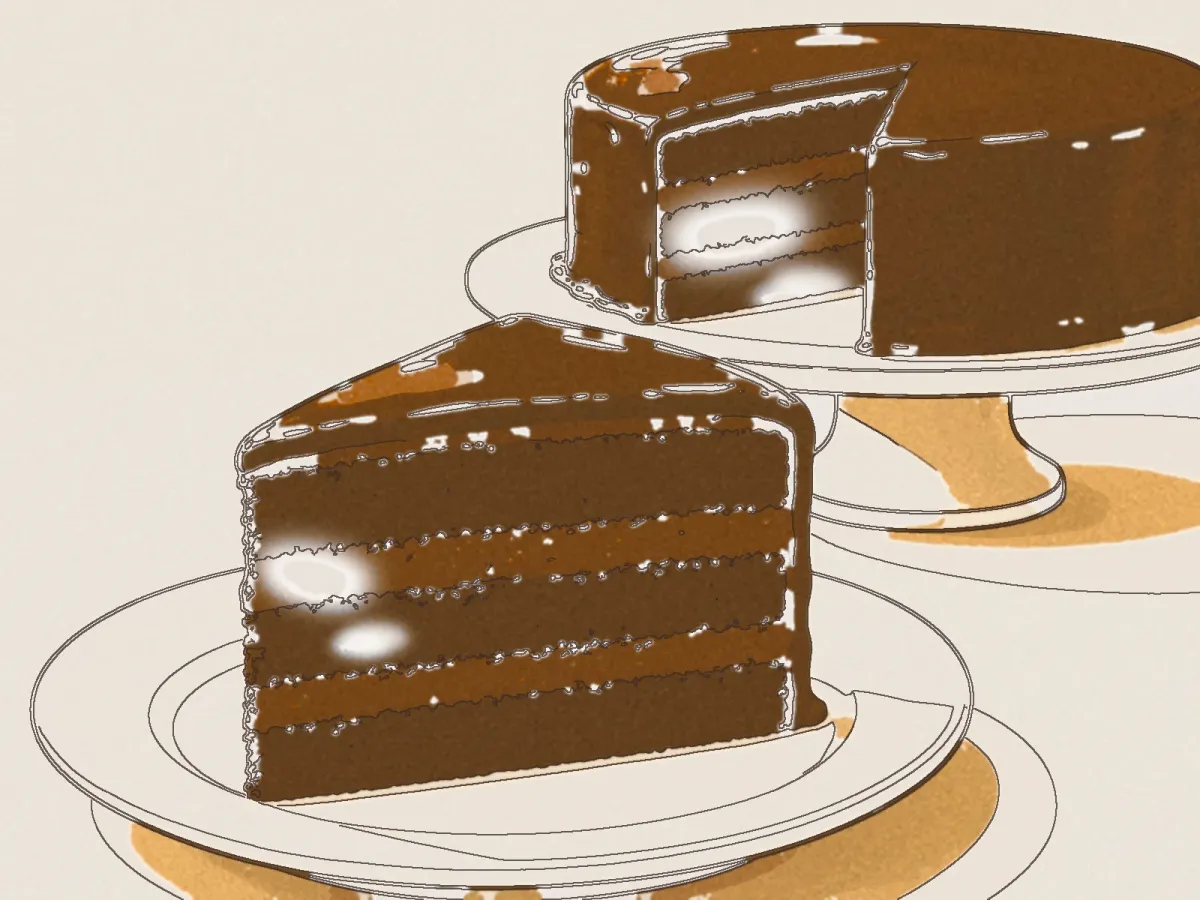
Inspired by Kiki's Delivery Service. An elderly lady (a customer of the delivery service, not the baker) bakes a chocolate cake for the young courier to thank her for her help, and also asks for her birthday so she can make her another one.
Una tarta de chocolate de agradecimiento, con el nombre de la destinataria; sin spoilers del resto de la trama.
Kiki's Chocolate Cake
A moist cocoa sponge with a glossy ganache topping (chocolate melted into warm cream): a cake made to say thank you.
approx. 385 kcal · light bite
1 h 10 min · base recipe for 8 servings
Kiki's Chocolate Cake
Ingredients
- 180 g plain (all-purpose) wheat flour
- 40 g unsweetened cocoa powder
- 150 g sugar
- 2 eggs (110 g)
- 100 ml oil
- 150 ml whole milk
- 1 g salt
- 100 g 70% dark chocolate
- 50 ml whipping cream (heavy cream)
- 2 tbsp (30 ml) hot water
Get ready
- Wash your hands with warm water and soap and dry them well. Wash them again every time you touch raw egg. Take the eggs out of the fridge 15 minutes ahead so they mix in better.
- Weigh and measure everything: 180 g flour, 40 g cocoa, 150 g sugar, 2 eggs, 100 ml oil, 150 ml milk, 1 g salt, 100 g 70% dark chocolate and 50 ml cream.
- Cut a circle of baking paper the size of the base of the 20 cm pan.
- Set aside about 5 ml (1 tsp) of the measured oil to grease the pan; the rest goes into the batter.
- Put the oven rack in the middle and leave the cooling rack free on the countertop.
- Bring a little water to the boil (for the 2 tbsp of hot water and to warm the knife when serving).
- Clear the countertop and keep oven gloves and a timer within reach.
Tools
- Kitchen scale
- 20 cm round cake pan
- Baking paper
- Pastry brush
- Fine-mesh sieve
- Large bowl and small bowl
- Hand or electric whisk
- Silicone spatula
- Long toothpick or skewer
- Chef's knife and a steady chopping board
- Small saucepan
- Glass bowl for the ganache
- Cooling rack
- Oven gloves
- Timer
Steps
- Turn the oven on to 175 °C (350 °F) with top and bottom heat, without the fan if you can, with the rack in the middle. Let it preheat while you make the batter, about 10 minutes.An oven that hasn't reached temperature gives you a sunken cake or a gummy crumb.
- Use the brush to grease the 20 cm pan with the teaspoon of oil you set aside: base and sides, no puddles. Lay the circle of baking paper on the base and smooth it out.
- Set the sieve over the large bowl and sift the 180 g of wheat flour, 40 g of cocoa powder and 1 g of salt, tapping the side with your hand. Break up any cocoa lumps left in the mesh with a spoon.Cocoa clumps and the lumps don't break up later: sifting now prevents bitter little pockets in the cake.
- Crack the eggs one at a time into a small bowl, to catch any bits of shell, and transfer them to the large bowl. Wash your hands with soap and water after handling them.Raw eggs can carry salmonella: don't taste the raw batter, and clean anything the egg has touched.
- Add the 150 g of sugar to the eggs and whisk for 4–5 minutes (electric whisk on medium-high) until the mixture is pale, thick and doubled in volume. When you lift the whisk, the batter should fall in a ribbon and leave trails that take a few seconds to disappear.This whisking is what gives the cake its air, since there's no baking powder: don't cut it short.
- With the whisk on low, pour in the 100 ml of oil (minus the teaspoon you used for the pan) in a thin stream and keep going for 20 seconds, until there are no streaks of oil.
- Pour in the 150 ml of whole milk and mix for 15 more seconds, without whisking hard. The mixture will be runny and light.
- Add the sifted dry ingredients to the large bowl in 3 batches, folding with the spatula (from the bottom up) until the dry flour disappears. Stop as soon as you can't see any.Run the spatula along the bottom of the bowl: flour tends to stay there in lumps.
- Add 2 tbsp (about 30 ml) of hot, not boiling, water and give it 3 turns with the spatula. The batter will be runny and glossy, like a thick cream that falls slowly.Hot water wakes up the cocoa flavor and softens the batter.
- Pour the batter into the pan, scraping the bowl with the spatula. Level it with the spatula and tap the pan twice on the countertop to get rid of big bubbles.
- Put the pan in the hot oven on the middle rack and bake for 30–35 minutes at 175 °C (350 °F).Don't open the oven door before 25 minutes: the rush of cold air can make the cake sink.
- After 30 minutes, check the cake: the top should be firm and slightly cracked, the edges pull away a little from the pan, it smells strongly of chocolate and it springs back when you press the center with a finger. Insert a toothpick in the center: it should come out with a few moist crumbs, no liquid batter. Once you see these signs, the eggs are fully cooked.If the toothpick comes out with liquid batter, give it 3 more minutes and test again.
- Take the cake out with oven gloves and leave it in the pan on the rack for 10 minutes. Run a thin knife around the edge, turn it out onto the rack and peel off the paper. Let it cool completely, about 25 more minutes: when you touch the base, you shouldn't feel any warmth.
- While it cools, chop the 100 g of 70% dark chocolate on a steady board with the chef's knife: hold the bar with a claw grip (fingers curled in) and cut pieces of about 5 mm, keeping the tip of the knife on the board and the handle in your fist.Small, even pieces melt evenly and don't burn.
- Heat the 50 ml of whipping cream in a saucepan over low heat, watching it closely, until it steams and small bubbles appear at the edge (about 80 °C). Take it off the heat before it boils.If the cream boils, the ganache can split and turn greasy.
- Pour the hot cream over the chopped chocolate in the glass bowl, covering all the pieces. Leave it for 2 minutes without touching it.
- Stir with the spatula, starting in the center with small circles that gradually widen, until the ganache is smooth, glossy and free of bits. If any hard pieces remain, warm the bowl for 10 seconds over a water bath or in the microwave.
- Let the ganache rest for 5–8 minutes, until it thickens like a chocolate spread and falls from the lifted spatula in a thick ribbon that holds for a moment.If you use it too runny, it slides off the sides of the cake; if you wait too long, it won't spread well.
- With the cake completely cool, pour the ganache into the center and spread it toward the edges with the spatula in a layer about 5 mm thick. Let it drip down the sides a little.
- Let the topping set for 10 minutes somewhere cool (or 5 in the fridge). Dip a long knife in hot water, dry it and cut the cake into 8 slices, wiping the knife between cuts.A warm, dry knife cuts through the topping without cracking it.
Allergens
Contains: gluten, huevo, lácteos.
May contain: soja, frutos de cáscara.
A guide only; always check the label.
Azúcar alto. La ración concentra bastante azúcar.
Per serving, approx.
Energy · 385 kcal
Week menu
Put this dish on a lunch or a dinner. The combined list adds up the whole menu.
Notes
Ninguna ficha incluye polvo de hornear o bicarbonato: la tarta sube con los huevos batidos (o con el vinagre, en la vegana) y queda densa y húmeda. No se ha añadido nada; se aconseja batir bien huevos y azúcar y no sobrebatir después.
Las 2 cucharadas (30 ml) de agua caliente de la original (y del resto de las versiones con huevo) figuran ahora como línea de ingredientes. La vegana no lleva ese agua.
Para engrasar el molde se separa una cucharadita del aceite de cada ficha; no cambia la cantidad total.
Ligera: la cobertura es solo para la parte superior en capa fina.
Sin gluten: aviso de la ficha sobre altramuces en la harina y trazas en el chocolate; reposo de 10 minutos de la masa.
Vegana: cobertura con 40 ml de bebida de soja para 100 g de chocolate; usar chocolate sin leche.
El tiempo total real (hornear 30–35 min + enfriar 25–40 min + cobertura) supera la hora de la ficha; el cuadro de tiempo de la ficha puede quedarse corto.
Passport
Mark it when you cook it. If you upload a photo, the stamp is sealed.
In other kitchens
No notes yet. The first one can be yours.